Decades of satellite data reveal polar sea ice trends
How satellite climate data records help scientists understand shifts in polar sea ice
EUMETSAT’s Dr Rob Roebeling and his co-authors examine decades of satellite observations to uncover striking changes in Arctic and Antarctic sea ice in a new case study. He explains the driving forces behind these trends and why continuous monitoring from space is needed to assess climate change accurately and to guide policymakers with reliable information.
Credit: OSI SAF
Roebeling and his co-authors Dr Hayley Evers-King and Dr Ben Loveday from EUMETSAT, Gwenaël Le Bras from the EUMETSAT Ocean and Sea Ice Satellite Application Facility (OSI SAF) and Météo France, and Dr Thomas Lavergne from the OSI SAF and the Norwegian Meteorological Institute recently published a case study highlighting key trends in sea ice extent in the Arctic and Antarctic for 2025.
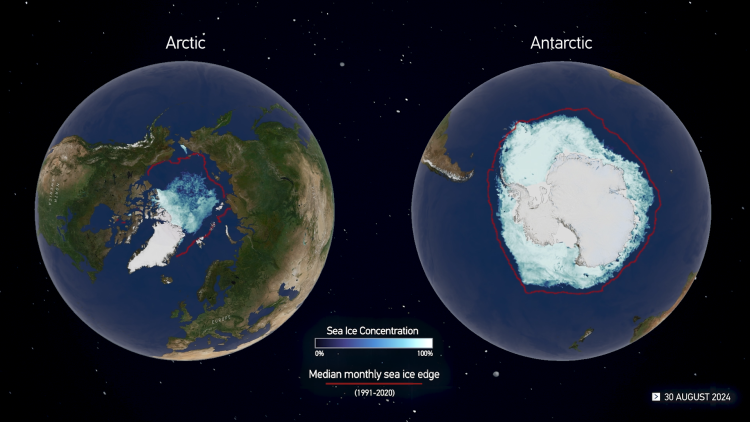
Analysing data records for the period 1979 to 2025 from the Ocean and Sea Ice Satellite Application Facility and the Pan-Arctic Ice Ocean Modeling and Assimilation System revealed a drastic decrease in sea ice extent in the Arctic until 2015, when the sea ice extent stabilised near the minimum level. The sea ice extent in the Antarctic, on the other hand, increased until the mid-2010s, when it started to decrease.
“Since 2015, the decline in sea ice extent has not been increasing, which is not so surprising because not much ice is left,” said Roebeling. “So, the sea ice extent has reached a kind of steady state and has stayed that way for a while.
“Things look a bit different in the Antarctic, where sea ice extent and volume seemed to be slightly increasing for a long time. But that is not the case anymore. The increase stopped around 2014 and then in 2017, started to reverse very slightly. Since then, in the summer, there has been almost no sea ice left in the Antarctic.”
Credit: OSI SAF
The authors also explored the causes for these changes in sea ice extent, noting two key contributing factors. One is the increased sea surface temperature affects the polar regions more strongly than the rest of the globe by melting the ice and snow that reflect sunlight. When they melt, the darker surfaces of the exposed water and land then absorb more sunlight, heating them up, and contributing to a positive feedback loop through which these effects amplify over time.
Another cause for the decrease in sea ice extent at the poles is atmospheric rivers. Through these atmospheric bands, warm water vapour from tropical and subtropical regions travels through the sky to the Arctic and Antarctica.
“Literature shows that atmospheric rivers are not only growing warmer and moister but also are becoming more frequent. Since the 1980s their number has risen by about 35% in the Arctic and 10% in the Antarctic,” said Roebeling.
The combination of warming oceans together with warmer and more numerous atmospheric rivers has led to decreased sea ice extent although the impact on any individual year is also subject to weather and climate patterns such as El Niño and La Niña, which can cause short-term variations.
“For the energy balance of the Earth, it is very important that we keep very accurate information on how much sea ice there is, because sea ice is super important for how our climate behaves,” said Roebeling. “It reflects a lot of light in summer, which keeps the Earth cool. So, as it disappears, our climate will warm faster.
“We need to continue monitoring sea ice so that we can see how the energy balance of the Earth is changing. Recent studies have raised concerns over the potential for abrupt changes in the North Atlantic climate system when too much ice disappears, which could have devastating effects on the climate in Europe and around the world over a very short time period. So, it remains critically important to monitor sea ice, as well as other ocean quantities, to diagnose what is happening and to deliver high-quality information to policymakers to guide their decisions.”
Author
Sarah Puschmann