EUMETSAT at 40
EUMETSAT marks a very special occasion as it enters its fifth decade as Europe’s meteorological satellite agency
EUMETSAT is celebrating the 40th anniversary of its founding Convention entering into force on 19 June 1986. Created to establish, maintain and operate Europe's key meteorological satellite systems, EUMETSAT programmes provide data critical to weather forecasts, hazard warnings, early warning systems, and other Earth observation and climate services delivered by the national meteorological services of its 30 Member States and beyond.
Hands-on start
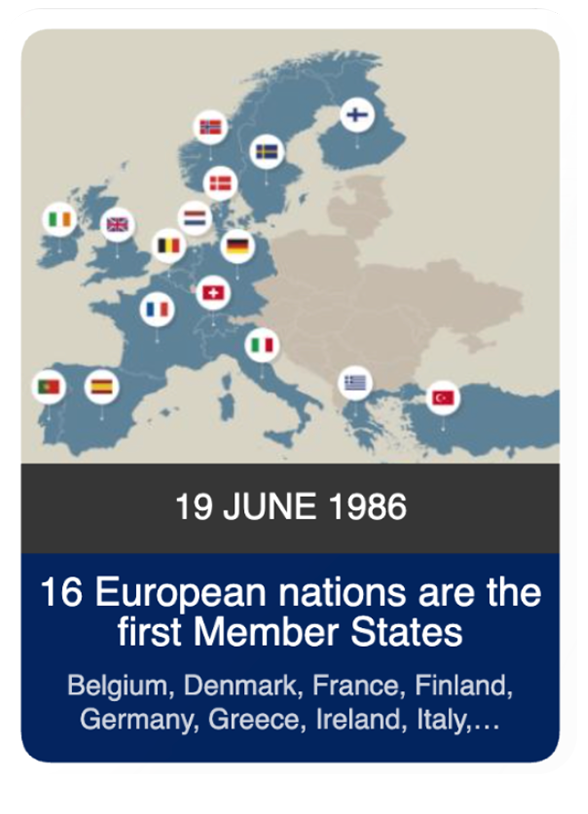
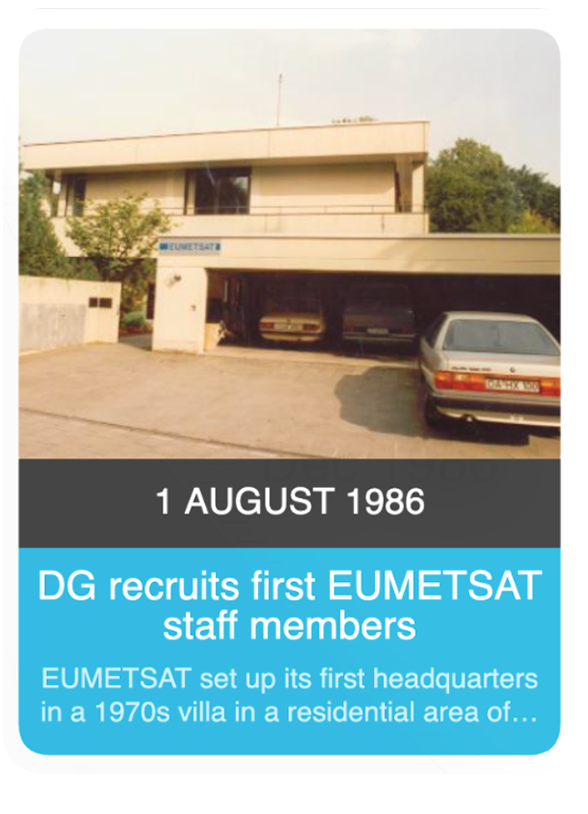
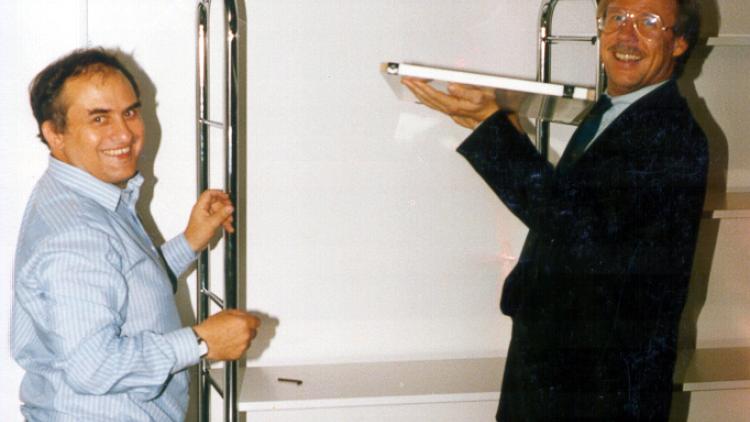
When representatives of 16 founding Member States met at the European Space Agency's headquarters in Paris on 19 June 1986, they officially launched EUMETSAT that very day. By August, operations began in a villa on Am Elfengrund, a residential area of Darmstadt, with four staff assembling shelves and improvising as they went.
From the start, John Morgan recalled, EUMETSAT could rely on the support of its neighbours – including the European Space Agency, who ran the first Meteosat programme, whose European Space Operations Centre (ESOC) sat just down the road
“On the very first day we moved to Darmstadt, one of the first people I met was an old friend who worked in the general services at ESOC – a person you could just phone up and say: we need a table!” he recalled. “As we had no furniture, I would call him and in due course a table would arrive.”
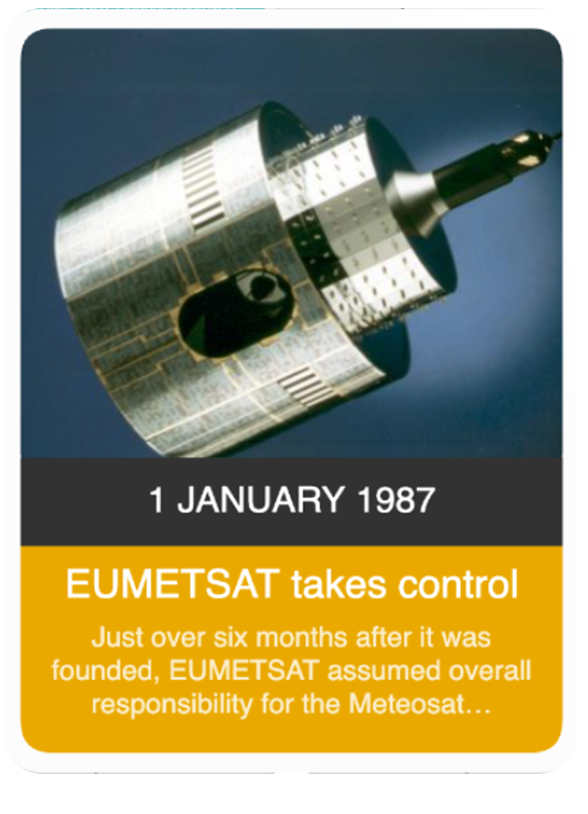
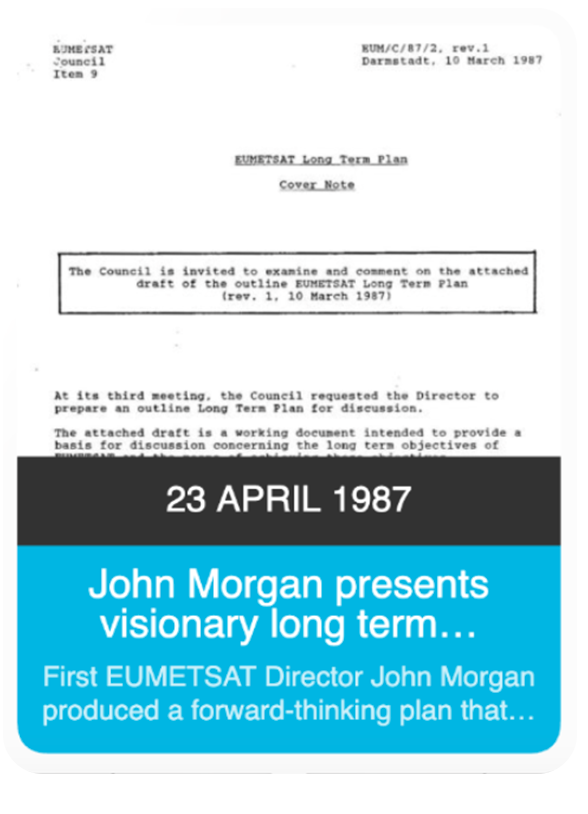
The ad hoc set-up was unusual but efficient. By January 1987, EUMETSAT had assumed responsibility for the Meteosat programme from ESA, which continued to operate the satellites on its behalf. That April, Morgan presented a long-term plan, approved by the EUMETSAT Council in September. In 1989, EUMETSAT oversaw its first launch – Meteosat-4.
Credit: EUMETSAT
Internationally minded
That instinct for partnership extended quickly to the international stage. Within six months of its founding, EUMETSAT had joined the Coordination Group for Meteorological Satellites – an international forum where weather satellite operators coordinate data and contingency cover – whose permanent secretariat EUMETSAT has hosted since 1995. EUMETSAT also forged early collaboration agreements with the World Meteorological Organization and the European Centre for Medium-Range Weather Forecasts.
Cooperation has taken many forms since – built on long-standing partnerships with ESA, the EU's Copernicus programme, industry, research and many others across Europe and beyond. With the US National Oceanic and Atmospheric Administration, EUMETSAT shares polar-orbit observation through their Joint Polar System and has repositioned satellites to fill each other's coverage gaps. EUMETSAT also collaborates closely with African meteorological services – through data delivery via EUMETCast, training and capacity building – and contributes climate observations to international assessments, including those of the Intergovernmental Panel on Climate Change (IPCC).
Better data products
For Morgan, international cooperation was central to EUMETSAT's mission. “By having these joint discussions on improving products and on contingency planning, we've helped to ensure data continuity across the world,” he recalled.
The same instinct shaped EUMETSAT's operational data products. Rather than building a large in-house centre, the organisation set up the EUMETSAT Satellite Application Facilities – a distributed network of expert teams at Member State meteorological services and research institutes, producing data products for everything from numerical weather prediction, to nowcasting, to sea ice and climate monitoring.
“The way we were able to put satellite experts and forecast experts together in one organisation was critical in developing the new methods which are so powerful in forecasting today,” Morgan said. “The way to do that turned out to be setting up themselves where expertise could be developed. As a result, we have far more people working on the science of using satellite data than would have been possible if we had tried to do it centrally.”
Bigger and better things
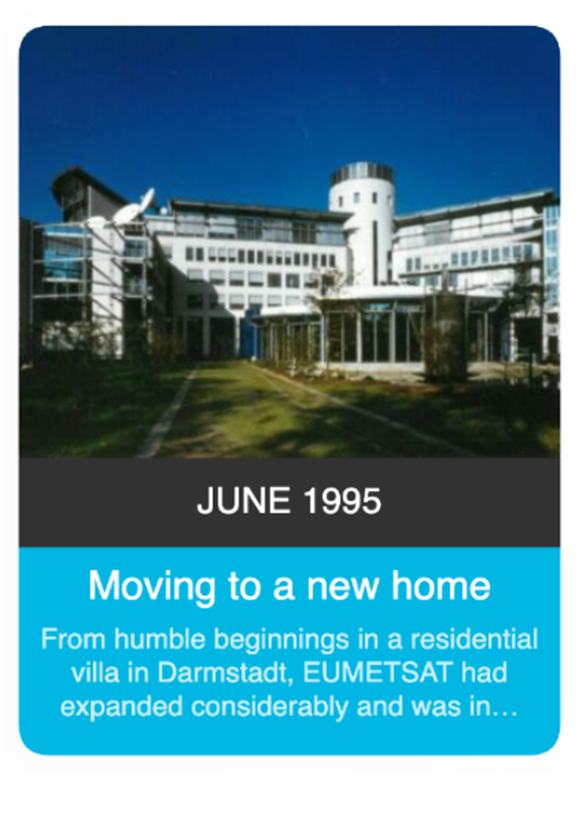
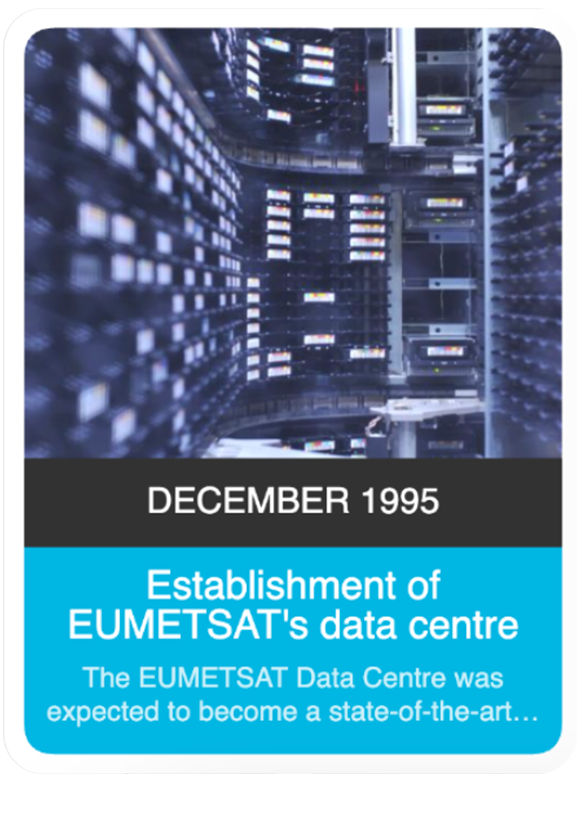
EUMETSAT outgrew its initial building within a decade. Today, the organisation’s spacecraft operators, scientists, software engineers, training coordinators and other professionals keep operations running round the clock from a purpose-built headquarters in the centre of Darmstadt.
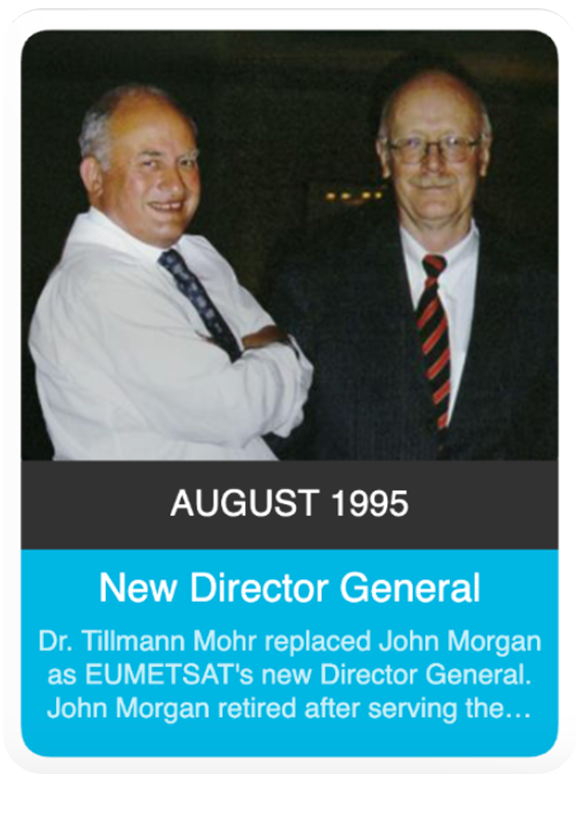
Morgan watched the development of the site and control centre come together, with the opening in 1995 coming just in time for his hand-over to EUMETSAT’s second Director-General, Dr Tillmann Mohr. “I walked into the main atrium and through to the control centre and thought: this is absolutely amazing,” Morgan recalled. “It was a wonderful occasion for me to see that, and a culmination of my endeavours over a long period of many years.”
Every day, EUMETSAT data inform weather forecasts and early warnings, track sea ice and ocean conditions, monitor atmospheric composition, and underpin decisions across shipping, aviation and renewable energy – as well as providing the long-term record on which climate research and policy depend.
For Morgan, the global scope of this work was clear from the start. “It’s no good just monitoring a little bit of the Earth, because some changes in one part of the world will be balanced by opposing changes in other parts. We have to monitor the entire world. Only satellites can do this.” Looking back on his own role, he added: “It was an extraordinary experience for me personally to be given the job of setting up an international organisation from scratch.”
Trusted in Space, Essential on Earth
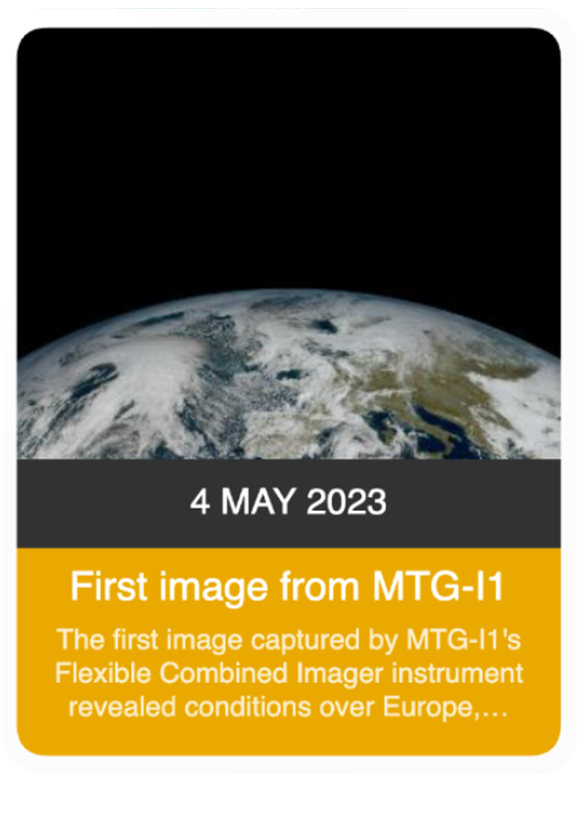
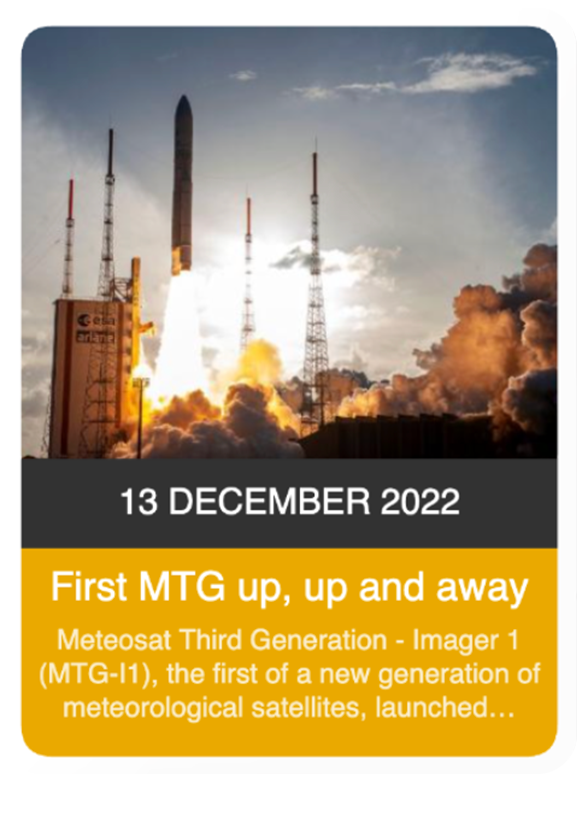
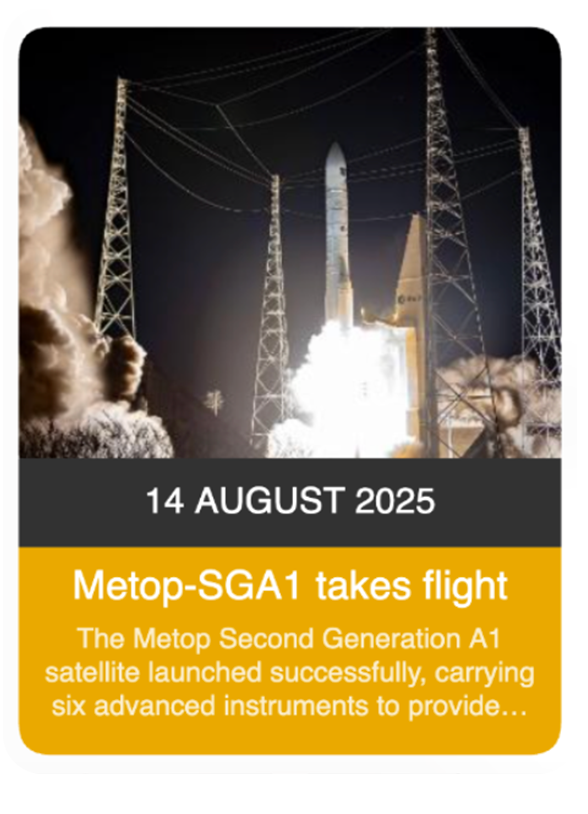
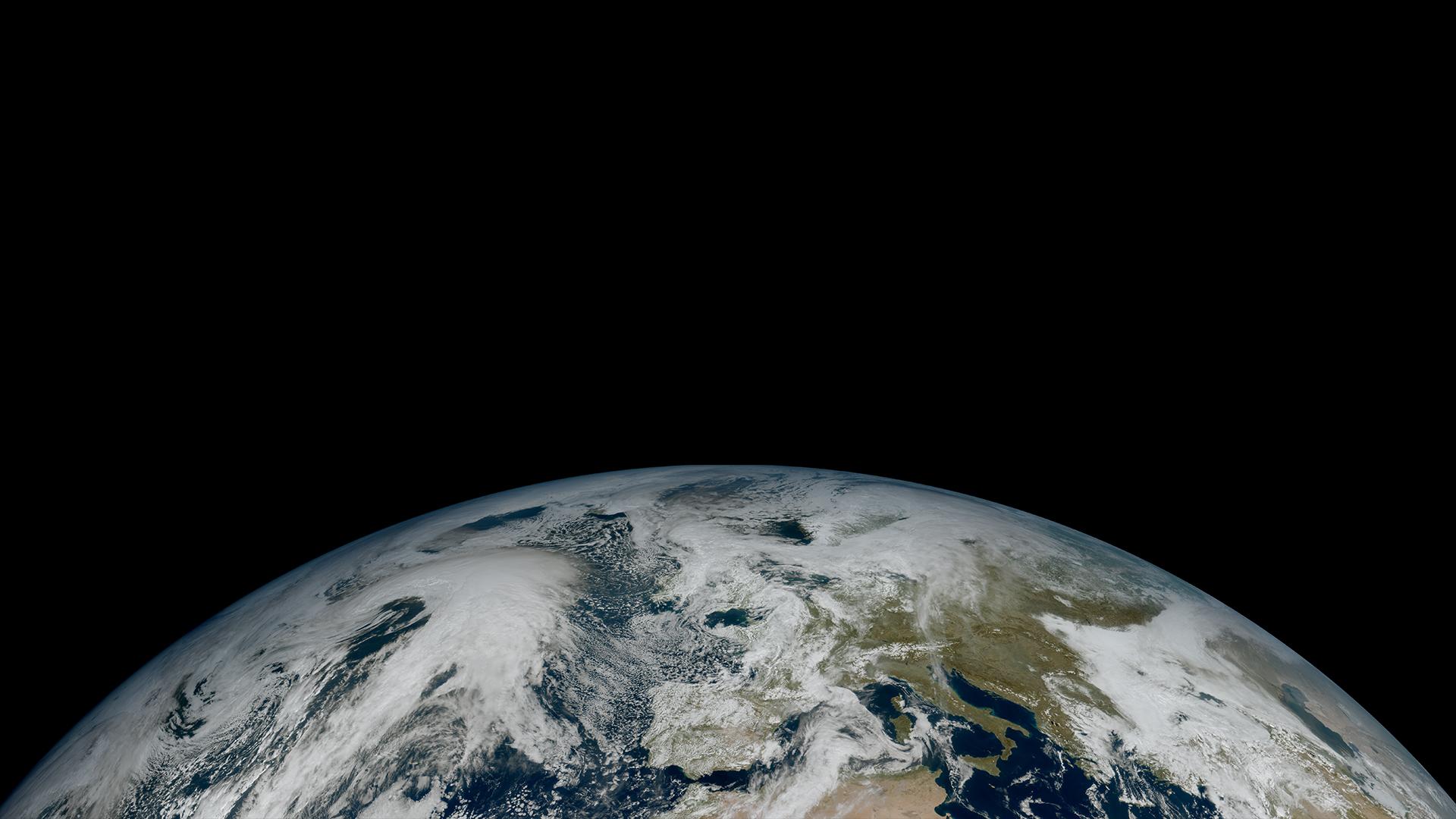
Four decades on, a new era of satellite Earth observation is taking hold. Next-generation satellites are reaching orbit, with three more launches due by the end of the year: the second Meteosat Third Generation Imager (MTG-I2), the first Metop Second Generation B satellite (Metop-SGB1) and Copernicus Sentinel-3C. A series of pioneering new missions are also taking shape, including the EUMETSAT Polar System – Sterna microsatellite constellation, which will support more accurate forecasts of extreme weather and the Copernicus Carbon Dioxide Monitoring mission (CO2M), which will detail human-caused carbon emissions from space. Meanwhile, CubeSats, commercial data, artificial intelligence and other emerging technologies are reshaping the field – and EUMETSAT continues to lead the way.
This article is based on an interview with John Morgan carried out by Lorna Putze and Stephen Killick in 2016.
Author:
Adam Gristwood
Reflections on 40 years
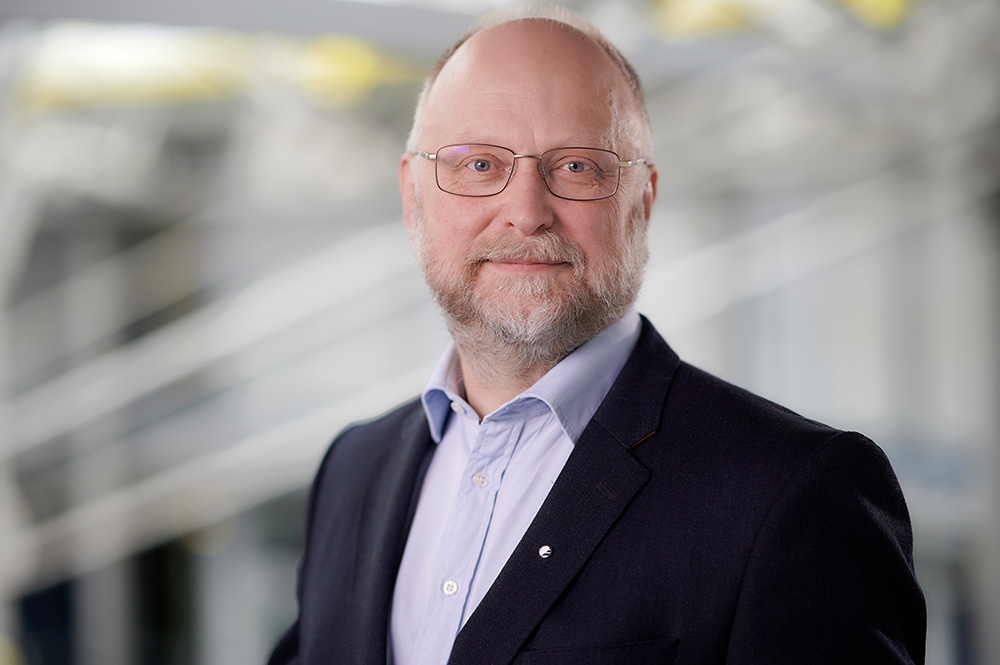
Phil Evans, Director-General of EUMETSAT: “Weather and climate intelligence has become critical infrastructure for modern societies. For 40 years, EUMETSAT's story has been one of ambition, determination, cooperation and innovation – and above all of steadfast service to our Member States and user communities. As we enter a new era of satellite capability, our focus remains clear: to deliver trusted data and services that help society anticipate and respond to a changing climate.”
Read the full 40th anniversary press release.
Madeleine Pooley joined EUMETSAT in 1986 as personal assistant to John Morgan and retired in 2013: “In the beginning I ploughed all of my energies into EUMETSAT – that was my world, that was my life. EUMETSAT is a fantastic organisation that is going places, and all the staff members are making a contribution to a better world.”
Silvia Castañer joined as a Legal Officer in 1990 and retired in 2024 as Director of Administration: “What I miss most in retirement is working with this bunch of international, committed, intelligent, interesting people. It is a privilege to work with people like this.”
Livio Mastroddi joined in 2013 as Director of Operations and Services to Users and retired in 2022: “EUMETSAT is a great environment where you can express yourself at every level and put forward new ideas. It is a great place to work – and that is something within the EUMETSAT DNA for forty years.”