Europe in 2025: extremes from the Arctic Circle to the Mediterranean
Major climate report documents record-breaking fires, heatwaves, melting ice and extreme ocean warmth across Europe
On 29 April 2026, the European State of the Climate (ESOTC) report 2025 was published by the Copernicus Climate Change Service, which is implemented by the European Centre for Medium-Range Weather Forecasts (ECMWF) on behalf of the European Union and the World Meteorological Organization.
Europe in 2025: heat extremes from the Arctic Circle to the Mediterranean
In July 2025, a high-pressure system stalled over Northern Europe, bringing the longest heatwave on record to sub-Arctic Fennoscandia, the region covering northern Norway, Sweden and Finland, almost double the previous record set in 2018. In Finland, temperatures exceeded 30°C for 22 consecutive days, one of the longest such streaks on record. Stations at Namsskogan and Gartland in central Norway recorded 13 consecutive days at or above 30°C, a new Norwegian national record. Locations as far north as the Arctic Circle also passed 30°C. Hospitals struggled to cope with rising admissions, and at least 67 people died in drowning incidents during July, a result of many seeking relief from the heat in open water.
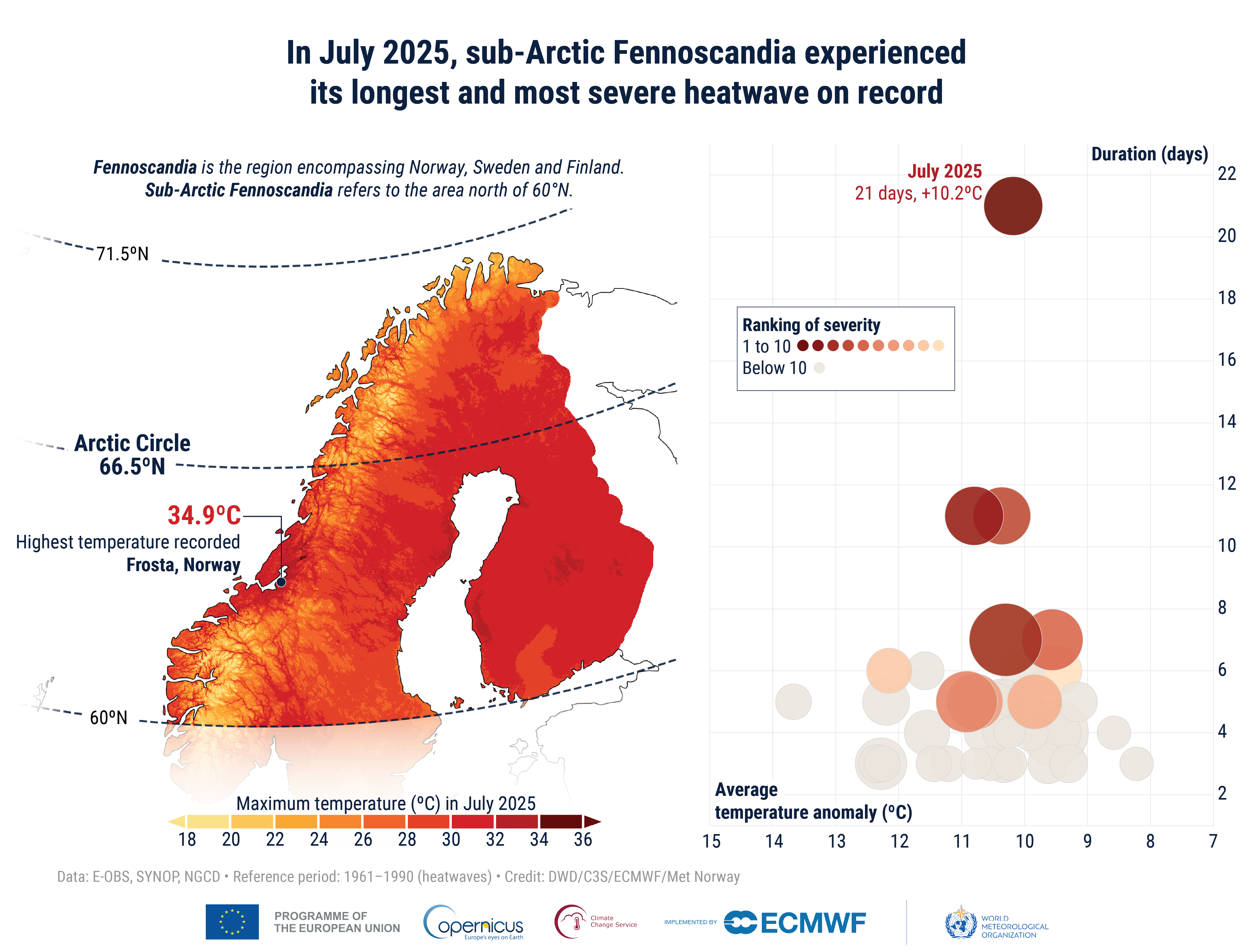
The sub-Arctic Fennoscandia heatwave was one of many extreme events across Europe in 2025, part of a wider trend in which such conditions increasingly affect not just the continent's south, but northern regions used to more moderate climates.
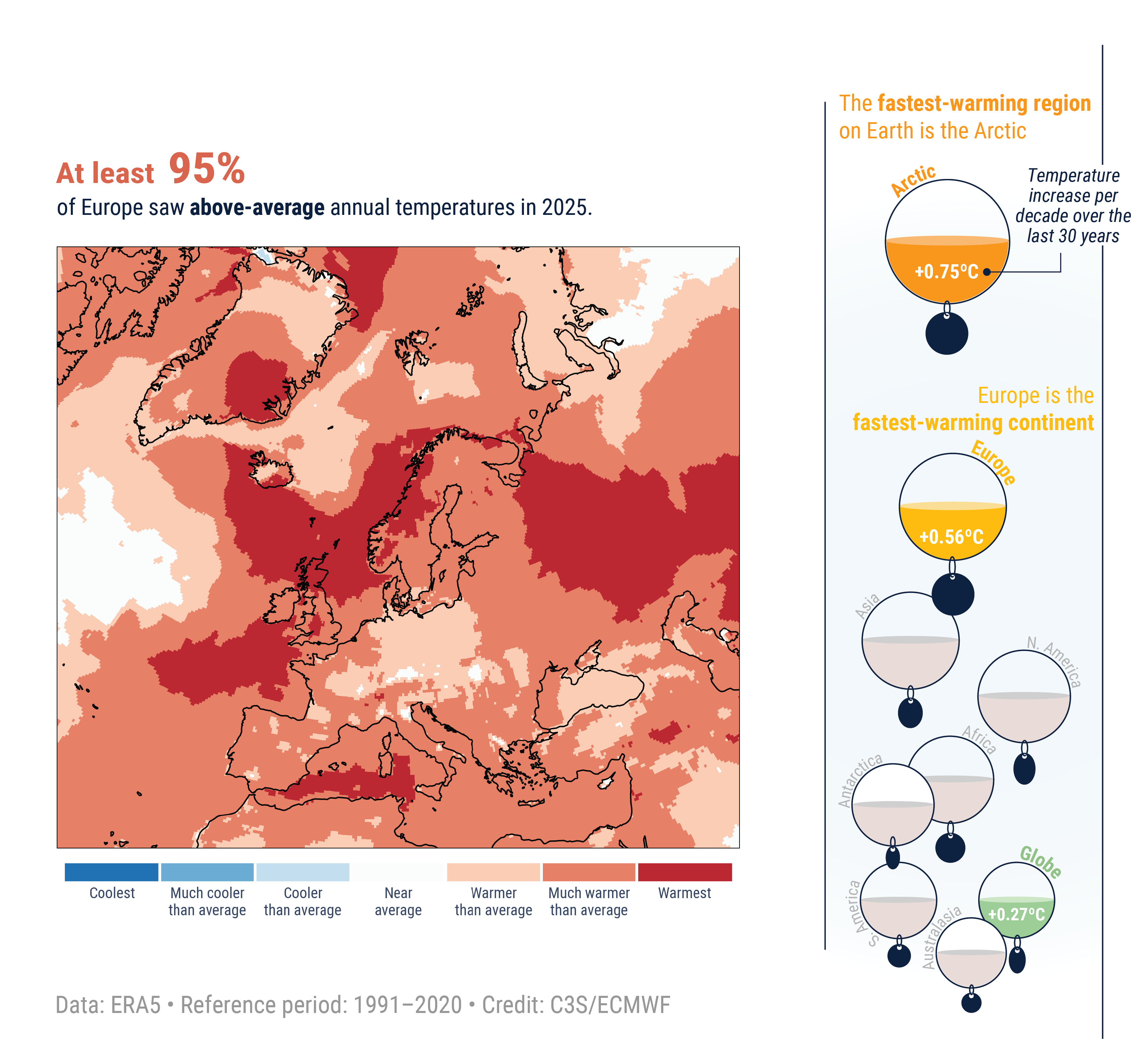
Europe is the fastest-warming continent, heating at more than twice the global average, with the Arctic region increasing faster still. The report finds that in 2025, at least 95% of Europe saw above-average annual temperatures, with several northern countries having experienced their warmest year on record. Five of Europe's warmest years have occurred since 2019. Globally, 2025 was the third-warmest year on record, with all the previous 11 years being the 11 warmest on record.
“The ESOTC 2025 paints a stark picture: the pace of climate change demands more urgent action,” said Dr Samantha Burgess, Deputy Director of the Copernicus Climate Change Service at ECMWF. “The evidence is unequivocal: climate change is not a future threat, it is our present reality. When we look at what our observations are telling us about Europe's climate, I'm struck by how directly these changes are affecting communities, ecosystems and the species that share this continent with us.”
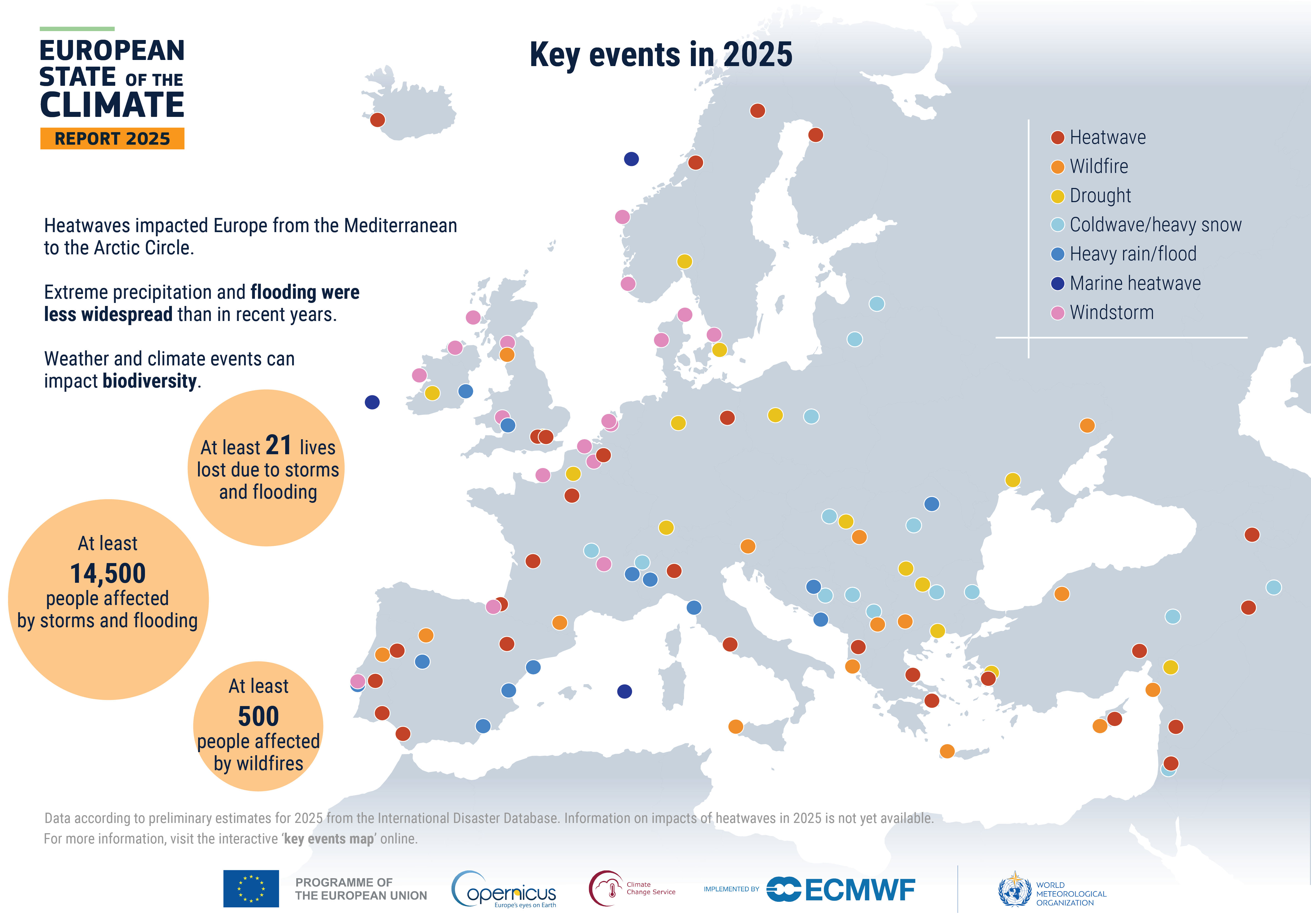
The sub-Arctic Fennoscandia heatwave was one of several severe heat events in 2025. In parts of Greenland, annual temperatures were up to 5°C above average. Across western Europe, the average temperature between mid-June and early July was the highest on record for the time of year, with Spain, Portugal, France and southern Britain particularly affected.
Extreme heat also affected Central and southeastern Europe in late June and July, with Slovenia setting a national June temperature record of 38.4°C. July saw Europe's second-most-severe heatwave on record, a 25-day spell across much of the continent. On 25 July, a record-breaking 50°C was recorded in Türkiye and temperatures continued to climb, peaking that day at 50.5°C at Silopi in the southeast of the country.
In August, a third heatwave struck the Iberian Peninsula and France, with temperatures reaching 45°C in Spain and 42°C in France. 2025 was one of the three driest years for soil moisture since 1992, with more than half the continent in drought conditions in May.
Europe in 2025: another year of record-breaking warm oceans
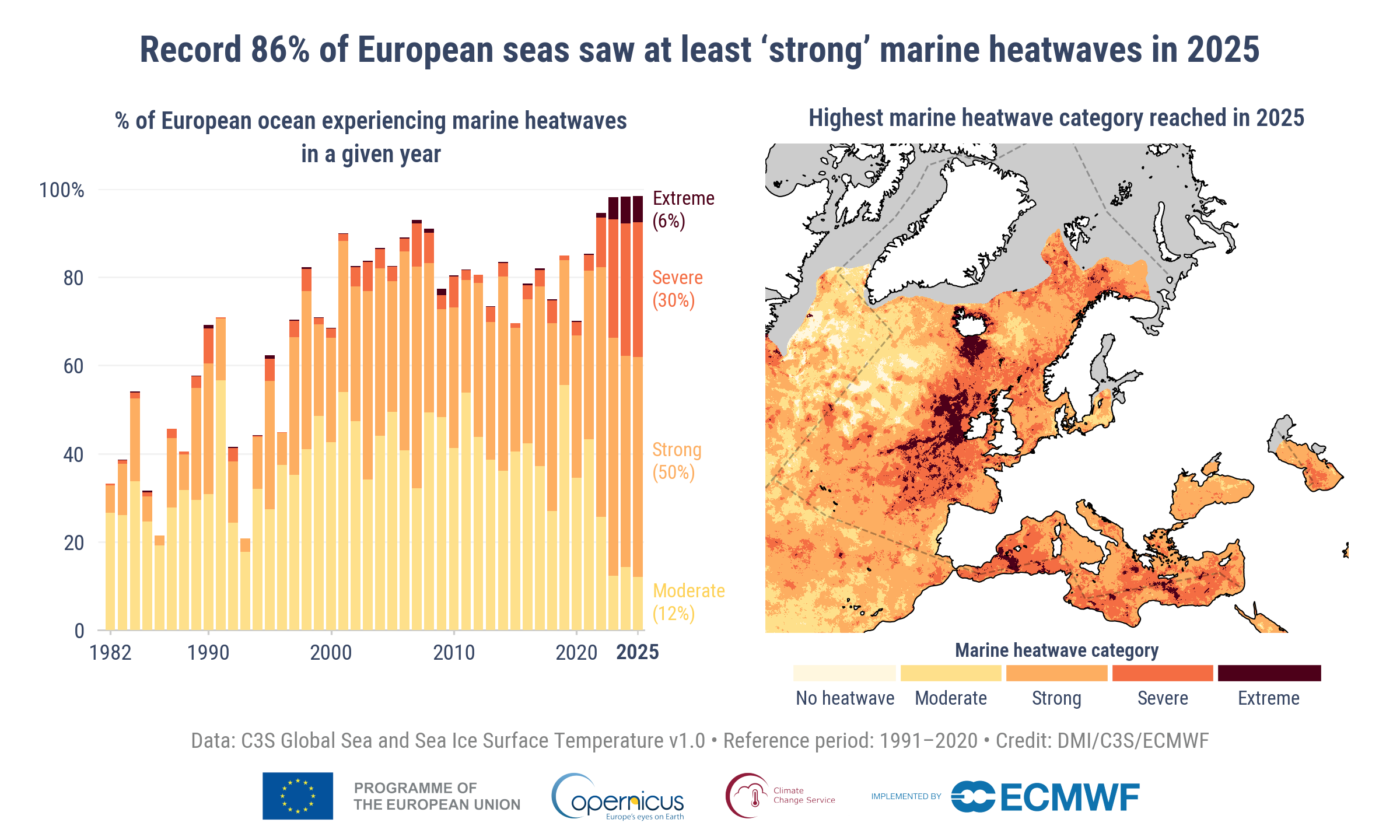
Marine heatwaves affected 86% of the European ocean region, the highest on record.
For the fourth consecutive year, European seas surpassed average annual sea surface temperature records, reaching 10.94°C, 0.65°C above average. The Mediterranean saw its second-warmest year on record, while in the Norwegian Sea, sea surface temperatures hit a record high on 24-25 July, the largest daily anomaly on record for the area, likely reinforcing the Fennoscandia heatwave.
Around 70% of Europe's rivers ran below average, with flows below normal for 11 out of 12 months.
Europe in 2025: rapid sea ice loss and decline of glaciers in the Arctic
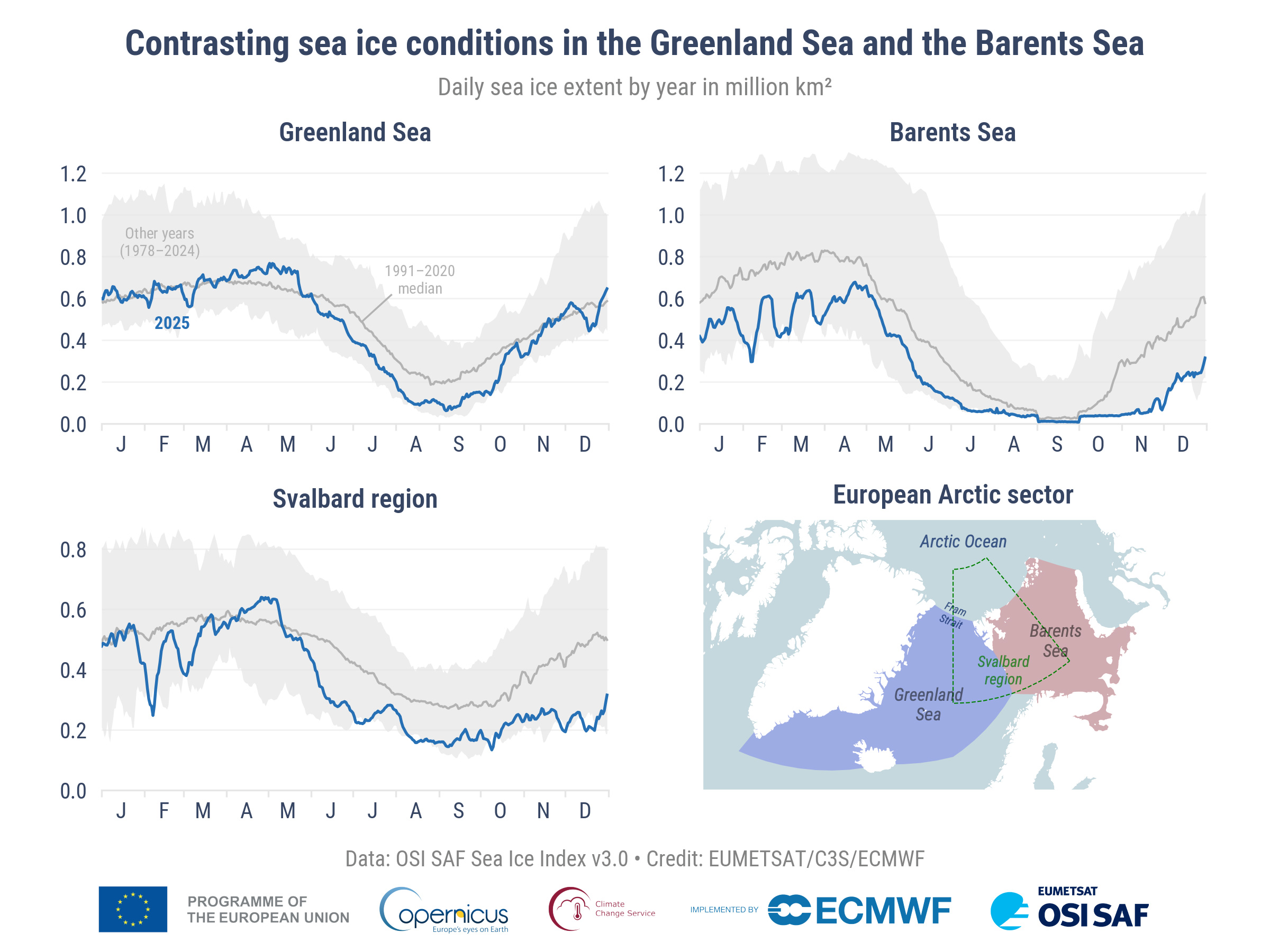
In late January and early February, ice in the Barents Sea and Svalbard melted at unprecedented levels that contributed to a new record low in global sea ice extent. By autumn, sea ice volume in the Barents Sea was 98% below average, and the extent was at monthly record lows in October, November and December, likely linked to much warmer-than-average sea surface temperatures that delayed freeze-up. The annual sea ice surface temperature for the European Arctic was the second highest on record. Sea ice across the European Arctic is tracked through EUMETSAT's Ocean and Sea Ice Satellite Application Facility (OSI SAF).
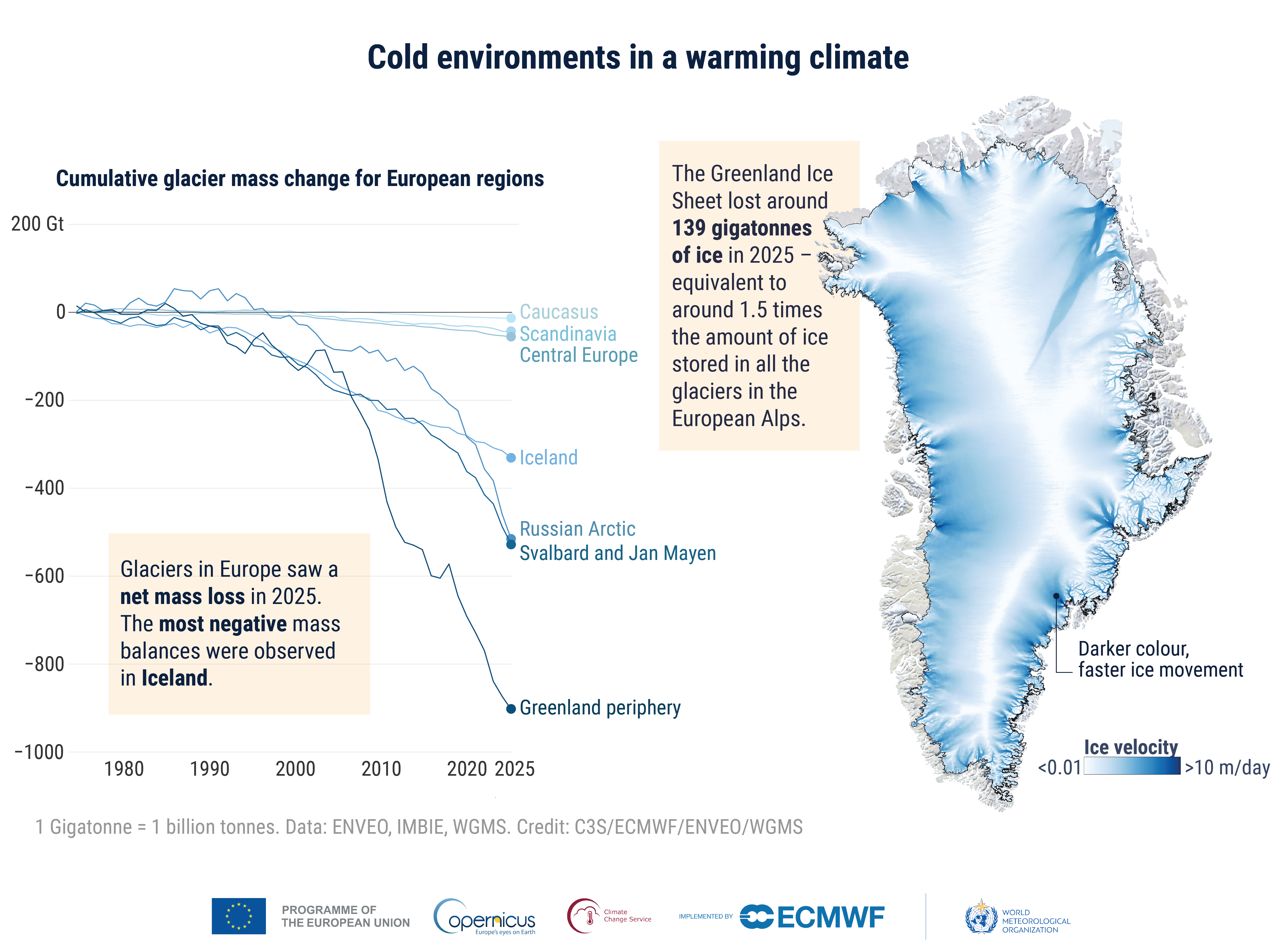
Across Europe, snow cover in March was around a third below the average, a deficit the report’s authors say is equal to the combined area of France, Italy, Germany, Switzerland and Austria. Iceland recorded its second-largest annual glacier mass loss, with the continuation of glacial retreat seen across the continent. The Greenland ice sheet shed 139 gigatonnes of ice, around 1.5 times the volume of all glaciers in the Alps. In May, more than half the continent experienced drought conditions.
Europe in 2025: Solar energy output boosted by sunnier conditions
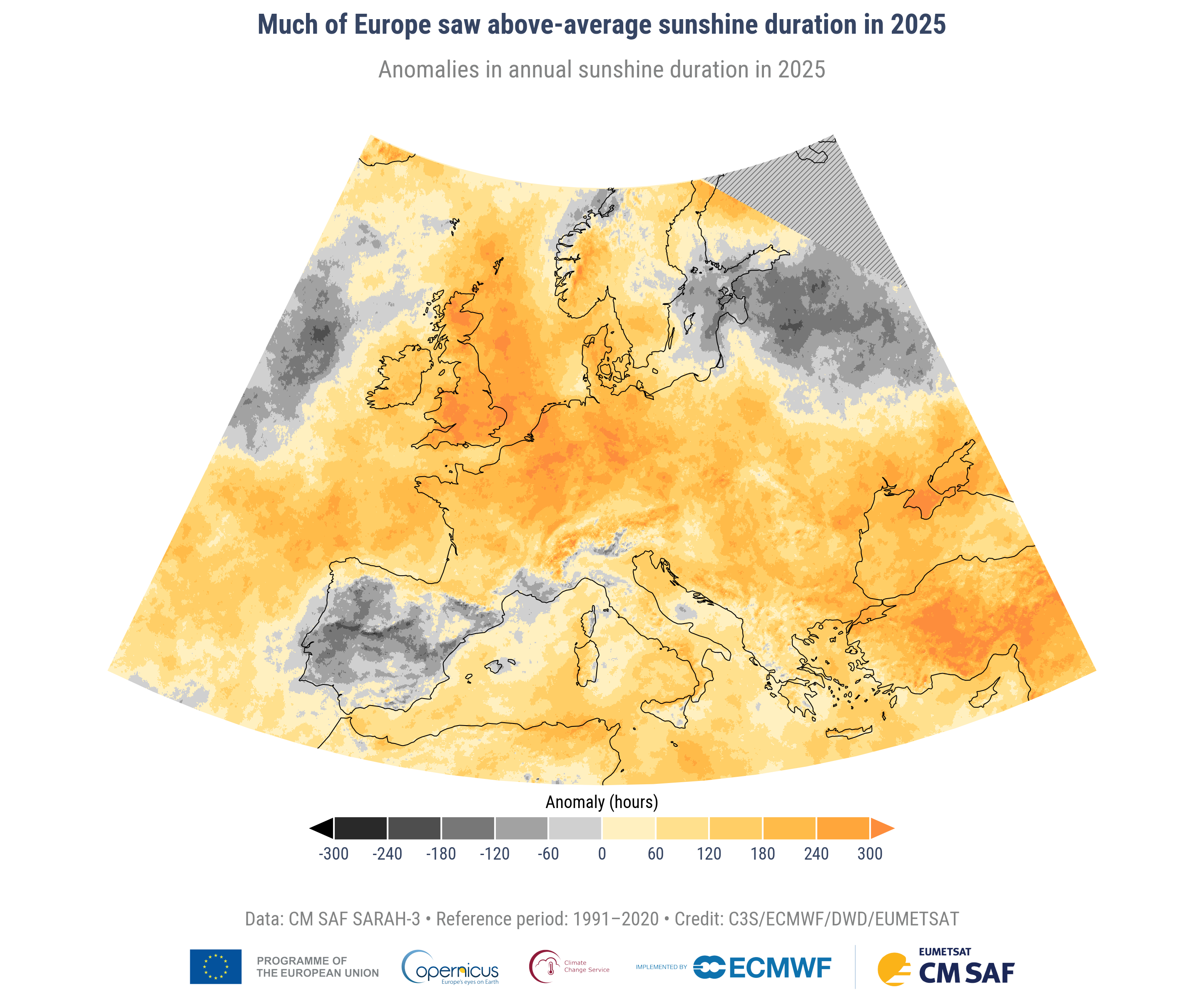
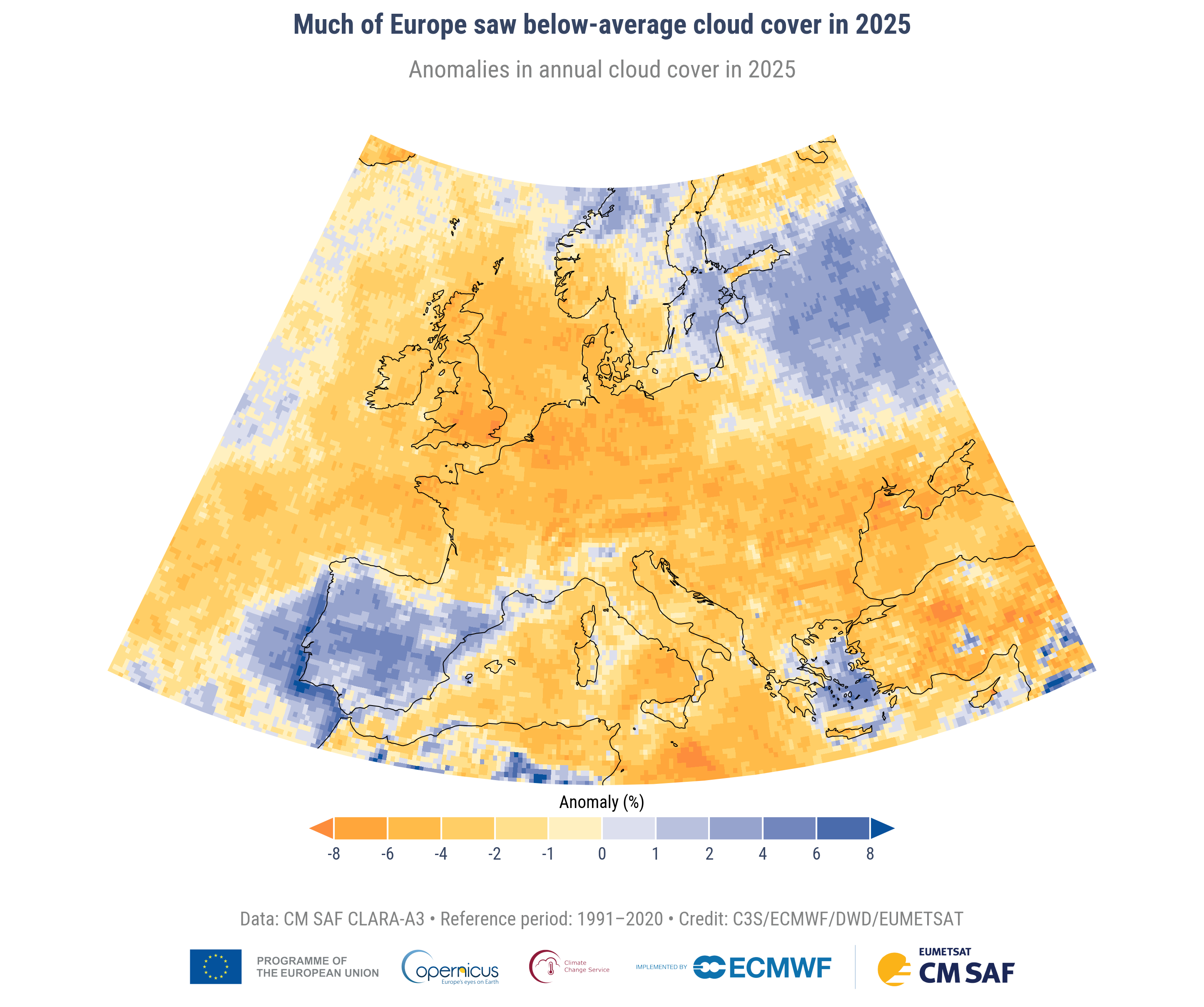
For four decades, Europe has seen a steady rise in sunshine and a fall in cloud cover. In 2025, sunshine duration across the continent was around 5% above average, with the United Kingdom recording its sunniest year on record and parts of Türkiye also seeing record-high sunshine duration. Data on sunshine duration in the ESOTC report were provided by EUMETSAT's Satellite Application Facility on Climate Monitoring (CM SAF), including a decades-long Meteosat record that makes long-term trends visible.
The 2025 weather patterns also influenced Europe's energy generation. Solar potential rose by up to 10% across the UK and parts of the Netherlands. The same patterns reduced wind speeds, cutting onshore wind potential by up to 25% around the Alps, southern Germany, western Czechia, Italy and Greece. Renewables supplied a near-record 46.4% of Europe's electricity in 2025, with solar energy setting a new contribution record of 12.5%. Wind and solar together continued to produce more electricity than fossil fuels – a milestone first reached in 2024.
Increased risks for societies and ecosystems
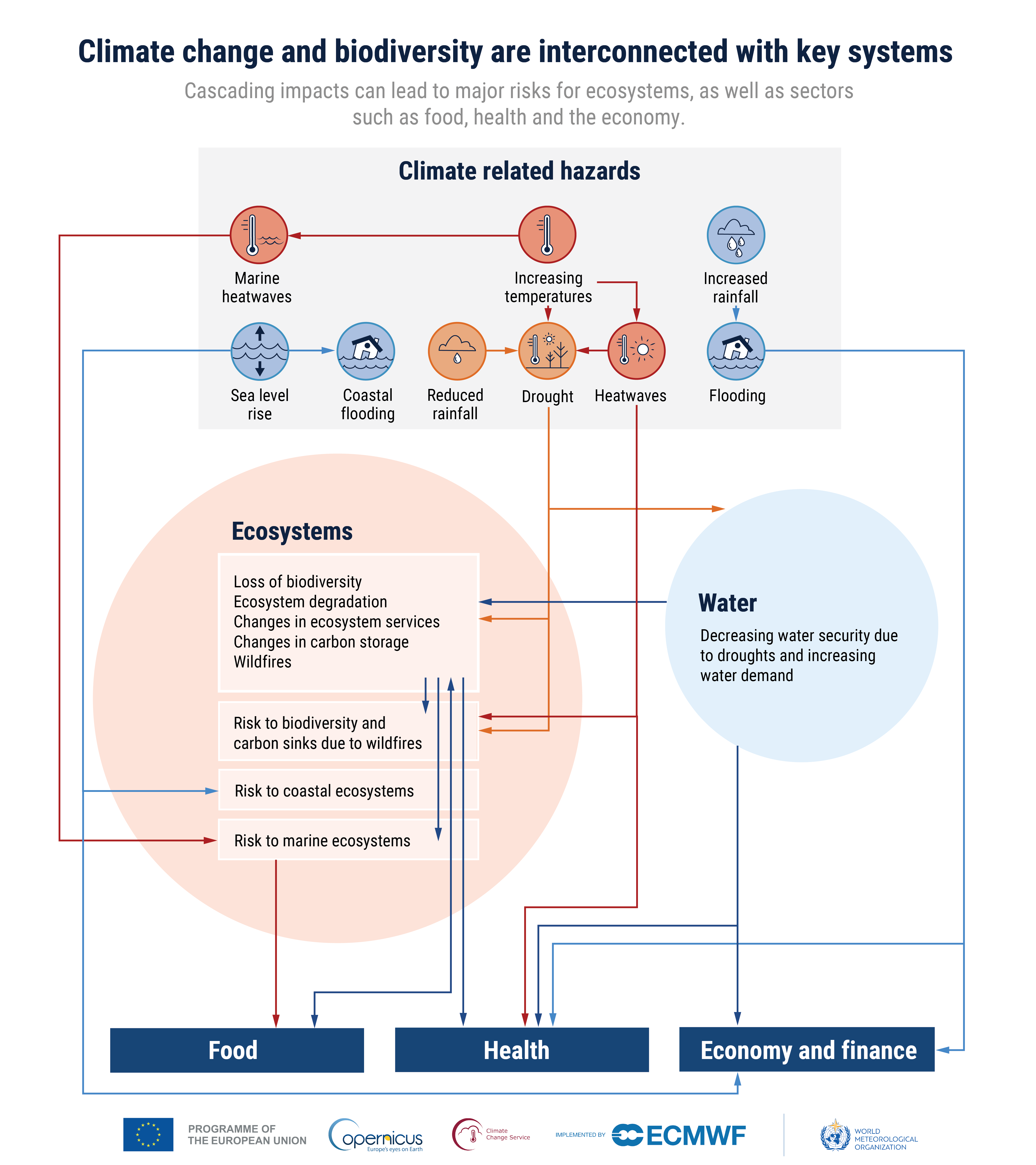
In recent decades, heat has been the leading cause of reported deaths from extreme weather in Europe, and heat-related mortality has risen by around 20% over 20 years. The IPCC estimates that even at 1.5°C of global warming, Europe could face 30,000 additional deaths a year from extreme heat, which could increase to up to 90,000 additional annual deaths if global warming were to reach 3°C. The pressures extend to ecosystems too, with the report warning that in 2025 marine heatwaves weakened critical marine habitats such as Mediterranean seagrass meadows and that on land many vital peatlands in northern regions exhibited extreme drought conditions.
“Europe is the fastest-warming continent, with heatwaves becoming more frequent and severe and biodiversity in decline,” said Dr Celeste Saulo, Secretary-General of the World Meteorological Organization. “Climate change drives biodiversity decline, which in turn accelerates climate change. These connections are strongly represented within European policy and frameworks, so actions are delivering results, but still, progress is slow. It will be virtually impossible to limit global warming to 1.5°C in the next few years without temporarily overshooting the Paris Agreement. What is important is to keep this overshoot as short and as shallow as possible.”
Beyond setting out the year's physical record, the ESOTC is a working tool for health authorities, energy operators, water managers and policymakers. EUMETSAT's next generation of satellites will extend climate records, essential inputs for ESOTC and other climate reports, over the decades to come.
“Climate variability and change have major impacts on our daily lives, and it is essential to monitor long-term changes to prepare for what is happening and to build a resilient future,” said Mauro Facchini, Head of the Copernicus Unit at the European Commission. “One priority is continuity, ensuring data is provided in the long term. Another is evolution: last year we launched four missions, including Copernicus Sentinel-4 and Sentinel-5 to monitor atmospheric quality. Later this decade, the Copernicus Anthropogenic Carbon Dioxide Monitoring mission will be the first to target worldwide anthropogenic greenhouse gas emission monitoring. Their contribution will be tremendous.”
Authors:
Adam Gristwood, Frank Kaspar and Rob Roebeling