Rewind and replay: a look at 40 years of data management at EUMETSAT
From magnetic tapes to data lakes and processing platforms, the handling of satellite data has changed dramatically over the decades.
The journey from early Meteosat archives to today’s cloud-native data services has transformed EUMETSAT into a powerhouse of satellite data management.
Sharing data is deeply rooted in the EUMETSAT Convention, but as new missions were launched, the volume of incoming data began to overwhelm its systems. In addition, the convention was then amended, broadening its scope to encompass the critical field of climate monitoring. Clearly EUMETSAT needed to expand its data management capabilities.

The first quantum leap for EUMETSAT storage came in 1995, when the Data Centre was established and work began on developing the Mission Archival and Retrieval Facility, evolving just two years later into the Unified Meteorological Archive and Retrieval facility (UMARF). As a central digital vault, UMARF consolidated all data from EUMETSAT’s expanding fleet of satellites and provided a single access gateway for users – mainly meteorologists and researchers.
Around the same time, EUMETSAT realised there was a need for the specialised development and processing of meteorological data products, which led to the creation of Satellite Application Facilities (SAFs). The SAFs are a network of research hubs within the national meteorological services of EUMETSAT’s Member States, and each was designed to focus on a specific climate or weather thematic area. Spain’s Agencia Estatal de Meteorología led the very first SAF, dedicated to very short-range weather forecasting. In those early days, specialised SAF products were fed back into the headquarters Data Centre, allowing users to discover and order them directly.
Six additional first-generation satellites followed Meteosat-1, but the real gamechanger arrived in 2002 with the launch of Meteosat-8, the first of the Meteosat Second Generation. Its advanced instruments would make the detection of sudden weather events, such as thunderstorms, snow and fog, a lot easier.
Then disaster struck. Shortly after launch, a critical onboard failure knocked out Meteosat-8’s direct-to-ground broadcast equipment. But adversity can lead to opportunities, and in trying to find a workaround to transmit these vital data, EUMETSAT used commercial telecommunications satellites to engineer a rapid solution: EUMETCast. This backup plan worked so effectively that EUMETCast became EUMETSAT’s primary mechanism for broadcasting near-real-time satellite data.
With EUMETCast successfully disseminating data, the next challenge was making this immense wealth of information more easily available. In 2008, EUMETSAT launched Product Navigator, an online catalogue that allowed an expanding community of users to browse and tap into current data and historical archives. This was one of EUMETSAT’s first major steps towards democratising Earth observation data, laying the digital foundations for what would become today’s EUMETSAT User Portal.
As data volumes continued to balloon, the digital infrastructure demanded a physical overhaul. In 2012, EUMETSAT inaugurated its state-of-the-art Technical Infrastructure Building. For the first time, the computing systems of all EUMETSAT satellite programmes were brought under a single roof, giving EUMETSAT the operational autonomy it needed to host the next generation of space mission data.
In 2014, EUMETSAT signed an agreement with the European Union to support its flagship Copernicus programme. Two years later, EUMETSAT reached a turning point. Anticipating an unprecedented flow of Copernicus environmental and climate data, EUMETSAT published its Challenge 2025 strategy, officially driving the organisation into the era of Big Data.
As part of delivering Challenge 2025, EUMETSAT launched a series of projects known as Data Services Pathfinders, resulting in a new suite of user-centric digital data services. Tools like Data Store and Data Tailor allowed scientists to filter, reformat and crop datasets before downloading them, while Hosted Processing let them run programming code right next to where the data lived. EUMETView, an interactive online data viewer, allowed anyone, from meteorologists to the public, to visualise satellite imagery across the globe in real time.
Alongside the development of these tools, EUMETSAT launched the Sentinel-3 Copernicus Online Data Access (CODA) service, a streamlined 12-month archive giving open access to continuous marine data, together with the EUMETSAT Data Lake for the online hosting and provision of all EUMETSAT mission data.
The experience gained from these initiatives laid the foundation for the development of new digital data services and collaborative platforms. Towards the end of the 2010s, EUMETSAT partnered with the European Centre for Medium-Range Weather Forecasts (ECMWF) to set up the European Weather Cloud. This joint platform, built in conjunction with Europe’s national meteorological and hydrological services, provided a unified workspace for advanced weather research.
Shortly after, a consortium comprising EUMETSAT, the ECMWF, Mercator Ocean International and the European Environment Agency released WEkEO, a powerful one-stop shop that allows users to virtually process and analyse data from various Copernicus services and Sentinel missions without downloading hefty files.
Together, this suite of innovations, from the marine data of CODA and the cloud-based processing power of WEkEO to the collaborative ecosystem of the European Weather Cloud, marked further significant progress towards ‘data for all’.
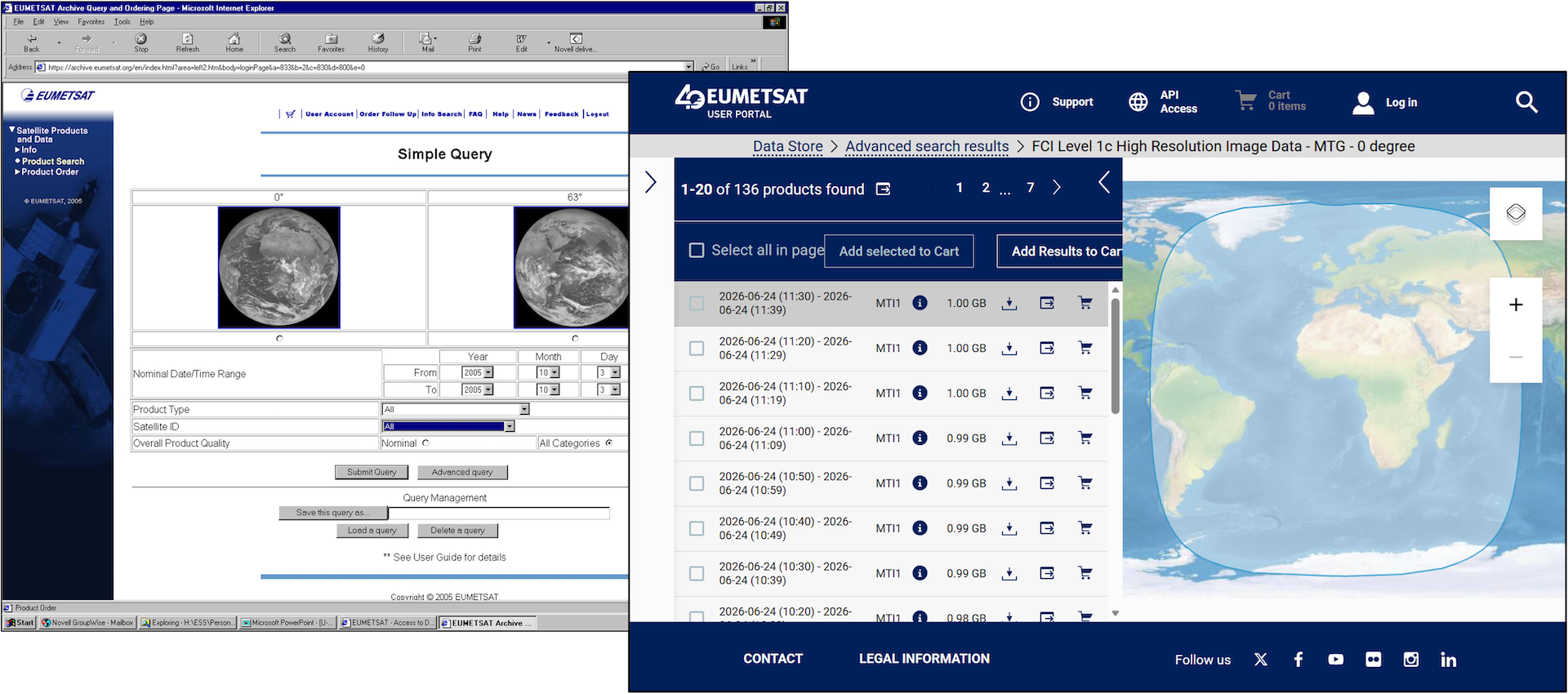
With these various cloud infrastructures in the works, EUMETSAT launched its next ambitious roadmap: Destination 2030. At its core, this new strategy aims to unleash the power of artificial intelligence (AI), applying it to Earth observation data to predict severe weather and climate events faster and more accurately than ever. As Destination 2030 took flight, the old digital architecture began to step aside. EUMETSAT’s Data Centre was no longer the main focal point for data access, passing the ball to the Data Store, which became the new way to access online EUMETSAT data.
This decades-long mastery of data management was exactly what made EUMETSAT uniquely qualified for one of its most ambitious challenges yet: Destination Earth (DestinE). Launched by the European Commission in 2022, DestinE centres around building a highly accurate digital twin of our planet to answer Earth system questions and help policymakers plan a sustainable future.
DestinE also has a data lake, and EUMETSAT was ideally placed to implement this digital backbone of the initiative. The DestinE Data Lake is a repository that provides access to enormous volumes of data from the Digital Twins and other data spaces, allowing users to process that data near to where it is produced through a distributed European infrastructure. Open to the public since 2024, DestinE has just entered its third development phase, which will take the initiative to full operations mode.
Every new generation of EUMETSAT satellites multiplies the acquired data by a factor of ten, leading to an archive size of petabyte proportions. Initiatives like the European Weather Cloud and DestinE allow scientists to effortlessly analyse and process large-scale global datasets without downloading a single file.
In full alignment with Destination 2030, EUMETSAT is establishing services for generating AI-ready datasets for meteorological and climate machine learning applications through initiatives like DestinE’s DEFAIR and EUMETNET E-AI. These initiatives will allow users to customise and transform data before loading them into AI frameworks, reducing the time and effort spent on preprocessing activities.
EUMETSAT’s 40 years of experience in data management – every platform launched and every byte of data stored – form the essential inputs to its Digital Data Services Strategy. Through constant dialogue and co-design with Member States and partners, EUMETSAT continuously evolves this strategy to ensure that meteorological data services, cloud infrastructure and AI developments meet the current and future needs of European users.
What began in 1986 as a small organisation has grown into a global cornerstone for enabling weather forecasting and climate monitoring. Backed by the unwavering support of its Member States, EUMETSAT remains deeply committed to empowering today’s and tomorrow’s users within those states and beyond. Moving forward, EUMETSAT will continue to push boundaries, delivering the vital information necessary to safeguard lives, protect property and secure our shared future.
Author:
Marta Curado Avelar