Greenhouse gases

Observing the Earth with Polarisation – Aerosol Events Captured by 3MI


Greenhouse gases
Greenhouse gases
Last Updated

08 May 2026

Published on

08 May 2026

Introduction

The 3MI instrument has been launched in August 2025 onboard the EPS-SG/A satellite. Since then, 3MI is continuously observing the Earth with its very special eyes. Indeed, 3MI has a unique capability of observing the polarized light coming from the Earth-Atmosphere system. Polarisation, being a property of light vibrating in a specific plan, called plan of polarization, is generated when the sunlight is interacting with the particles populating the atmosphere. The advanced characterisation of the various types of aerosols is the core mission of 3MI which will benefit the air quality prediction, weather forecasts, warning systems, as well as climate monitoring.

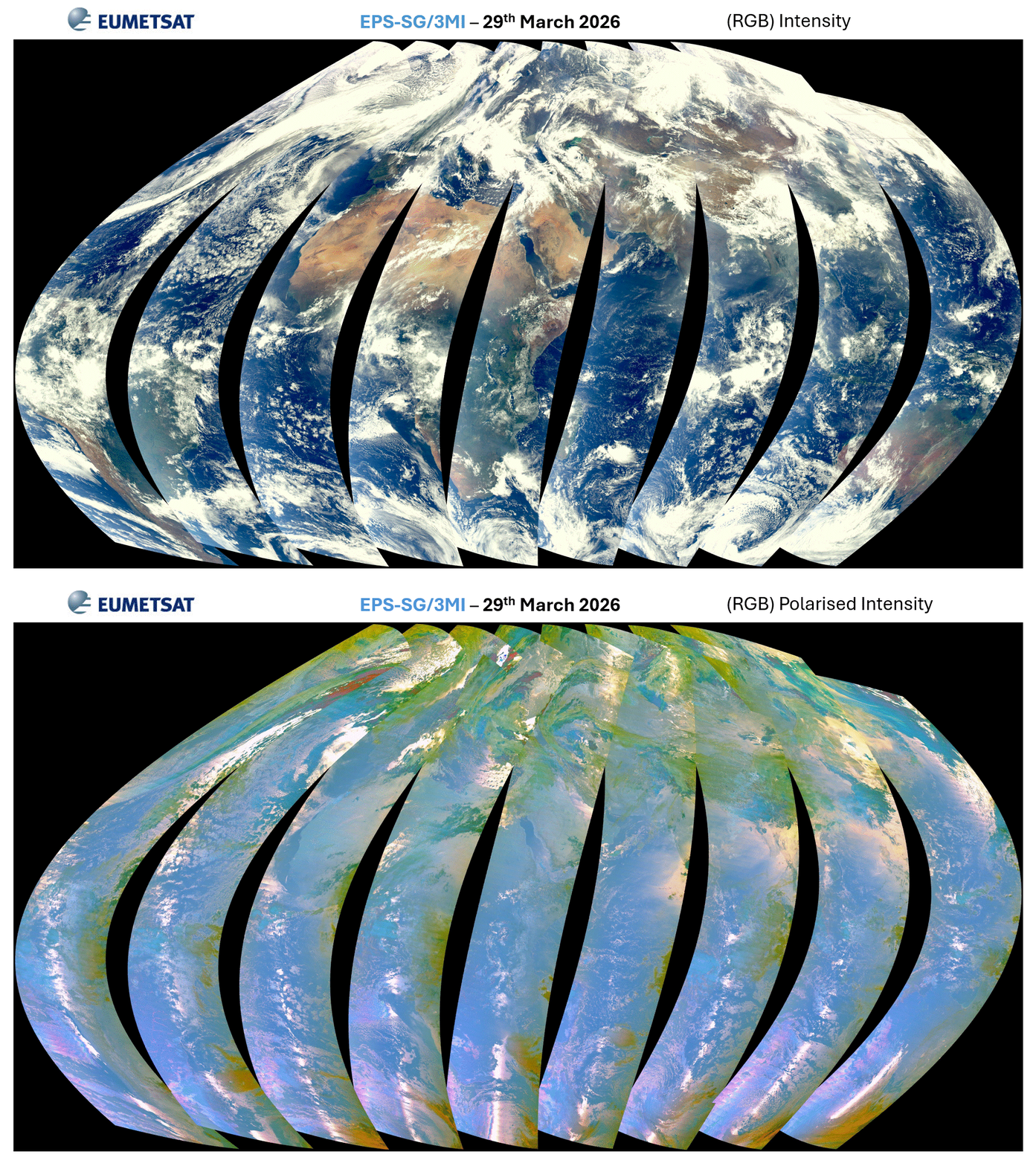
3MI has pictured this impressive collection of aerosol events. If in the classical RBG image (left) it is easy to recognize the land, clouds, and aerosols, the polarized RGB (right) shows some specificities which are good assets for the aerosol retrieval: for instance surface is in general much less visible (except for the reflection of the sun on water surfaces), and clouds usually appear grey or dark (except in the geometry of the rainbow, also called cloud-bow for liquid clouds). Images are based on a preliminary version of the 3MI Level-1 products. RGB are usually built using spectral bands 670, 555, and 443nm.

Enjoy !

Combined Aerosol Types in India and China

  • On the 19th Oct 2025, 3MI was observing in the same overpass the Indo-Gangetic Plain, the Tibetan plateau, and the Xinjiang province. In the first image, a very important aerosol load is observed in the Gangetic plain. In the polarised image, the surface mostly disappears (see for example the Tibetan plateau (middle)) and the aerosol plume filling a very large part of the Gangetic plain is nicely captured (bottom). On the same image, we may have the feeling the Xinjiang province (top) doesn’t evidence any significant aerosol background.
  • On the second image, the Xinjiang province is observed a couple of minutes before during the same overpass. Under this viewing geometry, very different from the first image, an important aerosol background is now revealed and fills the whole province, reaches about 2,000m height, and bordered all around with high mountains. This province is known for its very turbid atmosphere populated by natural dust mixed, especially in winter, with anthropogenic dust and urban/industrial pollutants. This comparison highlights the importance of a multi-angle viewing capability, in addition to the spectral and polarized ones, to better observe and monitor aerosols.

Wildfires in Patagonia (Chile)

  • In the early days, the fire is active around El Hayo region (middle of the image for 7th Jan 2026). The emitted smoke, visible in polarization with its reddish colour, is transported North and East, following different wind corridors, and is even mixing with clouds when reaching the Atlantic Ocean. A smoke column is also navigating toward West and transported over the Pacific Ocean.
  • On the 18th Jan 2026, the fire is very active in Conception. A massive column of smoke is moving up in the atmosphere and transported North-West over the Pacific Ocean. In polarization, the smoke plume reveals its complexity and evolution when travelling farther from the source.
  • On the 26th Jan 2026, the fire, still located in the Western part in Chile is transported toward East and moving up in the atmosphere where it is combined in a cloud structure over the South Atlantic Ocean. Again, the polarisation perfectly shows how the plume is evolving in properties, as well as vertically in the atmosphere.

Fine dust in the Bodélé Depression (Chad)

  • The Bodélé depression is known to be a source of fine dust carried across the Atlantic Ocean and being an important source of nutrient minerals for the Amazon rainforest. On the 14th Nov 2025, two important sources of aerosol, containing fine particles which create polarisation, are visible: dust coming from Bodélé when smoke from biomass burnings is coming from South-West.
  • The dominant North-East wind, becoming very strong when passing between Tibesti and Ennedi mountains, has a pronounced diurnal cycle. This strong wind extracts dust from the ground and shows its maximum in mid-morning which is also the time of the 3MI overpass. The image captured on the 10th Jan 2026 clearly shows the dust emitted the same morning (right) when the dust plume emitted the previous day is still visible (bottom).
  • The same very frequent situation, about 100 days a year, is observed on 23rd Feb 2026.

Wildfires and Biomass Burnings in South Africa & Amazonia

  • On the 30th Oct 2025, smoke mostly generated by biomass burning in Zambia and Mozambique reached Lake Malawi. Smoke, dominated by small particles, produces a very visible polarised signal.
  • During the New Year’s Day the 1st Jan 2026, smoke from biomass burning in Central Africa is visible bottom-right. A column of smoke generated by plantations in the middle of the Chad desert is also captured with polarization (up-right).
  • On the 18th Jan 2026, Central Africa is very active with biomass burning. The polarization evidences a lot of very small fires, the column of smoke each of them produces, and finally how they all merge in a general smoky atmosphere.
  • This spectacular Comet is captured on 28th Feb 2026. This smoke plume is generated by a fire in the middle of the Amazonia forest, and its very focused origin in the State of Roraima suggests it is originated from deforestation.

Aerosol Events in Indo-Gangetic Plain (India)

  • This impressive collection of images, pictures between during 12 days, from 31st October to 11th November 2025, the evolution of the atmospheric condition in the Indo-Gangetic Plain. It is clearly visible some of the major aerosol sources (from New Delhi to Calcutta). The aerosols, showing a very pronounced polarized signature, are a mixture of smoke from cropland fires and anthropogenic pollution.   

Desert dust wall from Algeria to Canary Islands

  • On the 30th Mar 2026, 3MI captured the 1,500km-long wall of desert dust, emitted a couple of hours before, and crossing Algeria North-East to South-West.
  • The following day, on the 31th Mar 2026, a very thick part of the dust plume reached the Canary Islands. The desert dust, nicely visible in the standard RGB, is also captured in polarisation providing additional information about the microphysics of the particles. On the left part of the image, a spectacular cloud bow, a rainbow appearing above liquid cloud, shows colorful irisation directly influenced by the size distribution of the liquid droplets at the top of the cloud. A beautiful back scattering peak is also observed top-left.
  • On the 1st April 2026, the impressive desert dust plume is moving Eastern over the Atlantic. A cloud bow is again visible top-left.