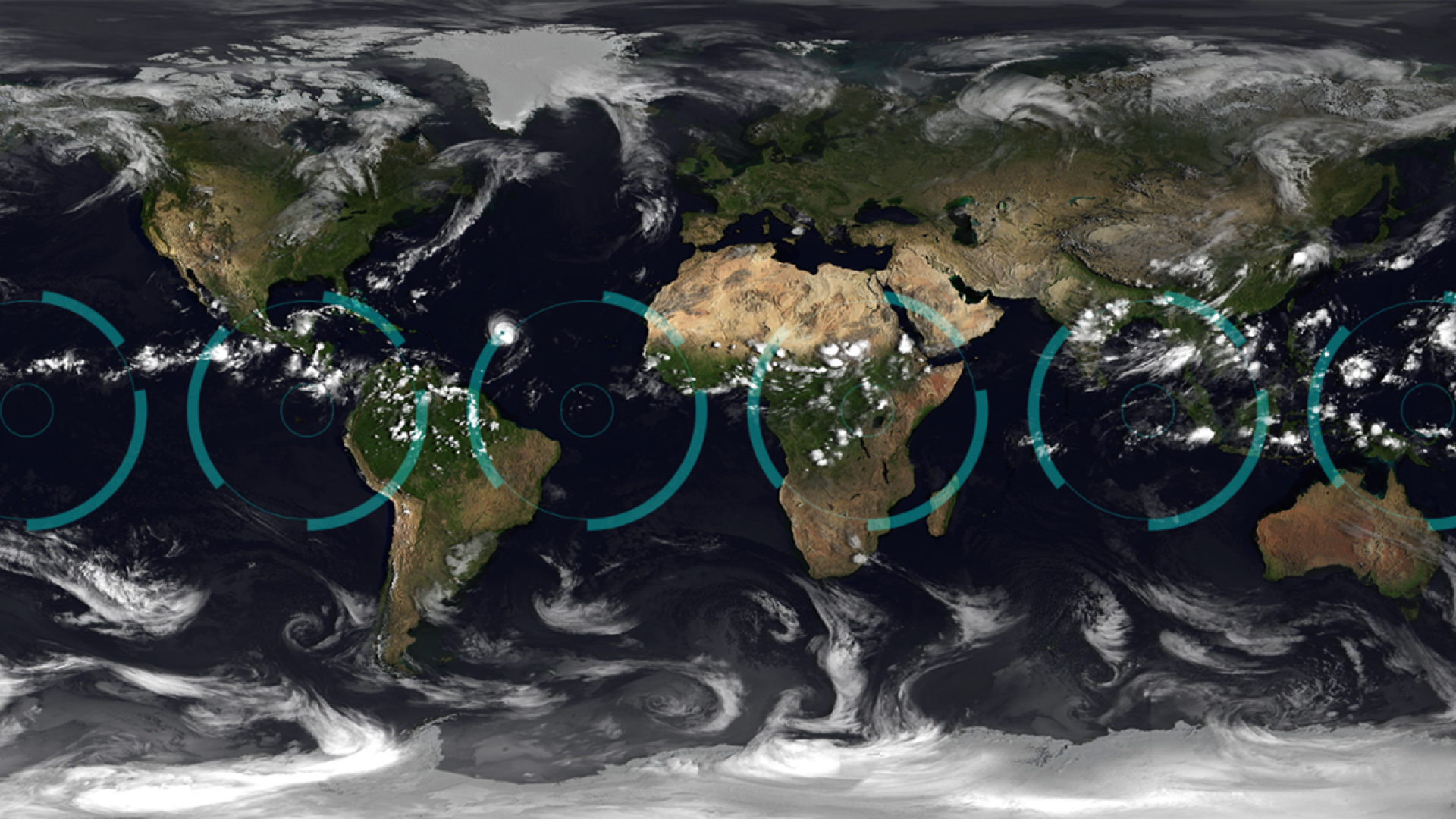
Weather and climate know no borders, so international collaboration is necessary to turn data provided by multiple space agencies into climate information that benefits societies around the world. The use of geostationary satellite data was pioneered by the WCRP GEWEX International Satellite Cloud Climatology Project (ISCCP) from 1983 by combining measurements from all geostationary satellites above the Earth’s equator for studying cloud climatology. The aim was to make first global cloud assessments and to coordinate research on cloud products and their use in climate models.
First GEO-Ring realisations provided 3-hourly data from two channels. Nowadays, individual satellites in the GEO-Ring can provide data every ten minutes for more than ten common channels. This has led to an increased capability to derive many more products from the observations in addition to using the data in data assimilation and an AI/ML context.
Concerted efforts of satellite agencies are ongoing to produce a GEO-Ring fundamental climate data record by addressing consistent quality control and recalibration as well as remapping to a common spatial and temporal grid.
The second GEO-Ring workshop held at EUMETSAT on 29 February – 01 March 2024 laid out the foundation for creating a GEO-Ring L1g data record. It was decided to produce a test data record of radiances for 2019 – 2024 and to distribute this to data users in order to understand whether it meets the needs for their applications.
This GEO-Ring test data was generated and the product and access details are available here.
The major objective of this workshop is to collect feedback from the users and to consolidate the specifications for generating the full GEO-Ring data record starting in the late 1970s.
The workshop will also discuss emerging user needs such as a provision with lower latency and additional potential usages in scientific applications.
This event is organised and hosted by EUMETSAT at its headquarters in Darmstadt. Participation is by invitation only.
A map of EUMETSAT’s headquarters and nearby hotels can be found here.