
16 December 2025
16 December 2025
These initial measurements from the satellite’s Poseidon-4 altimeter show how Sentinel-6B will help track sea-level change, ocean currents and wave conditions, while also monitoring water levels from lakes and inland waters — supporting safer navigation, better coastal protection and smarter water-resource management.
“These first observations already illustrate the value that Sentinel-6B will add as the next world’s reference mission for high-precision satellite altimetry well into the 2030s. Our teams, together with our European and US partners, are now entering the critical phase of calibration and validation to ensure we deliver the trusted data that scientists, forecasters and communities rely on to better understand and protect our oceans,” said EUMETSAT Director-General Phil Evans.
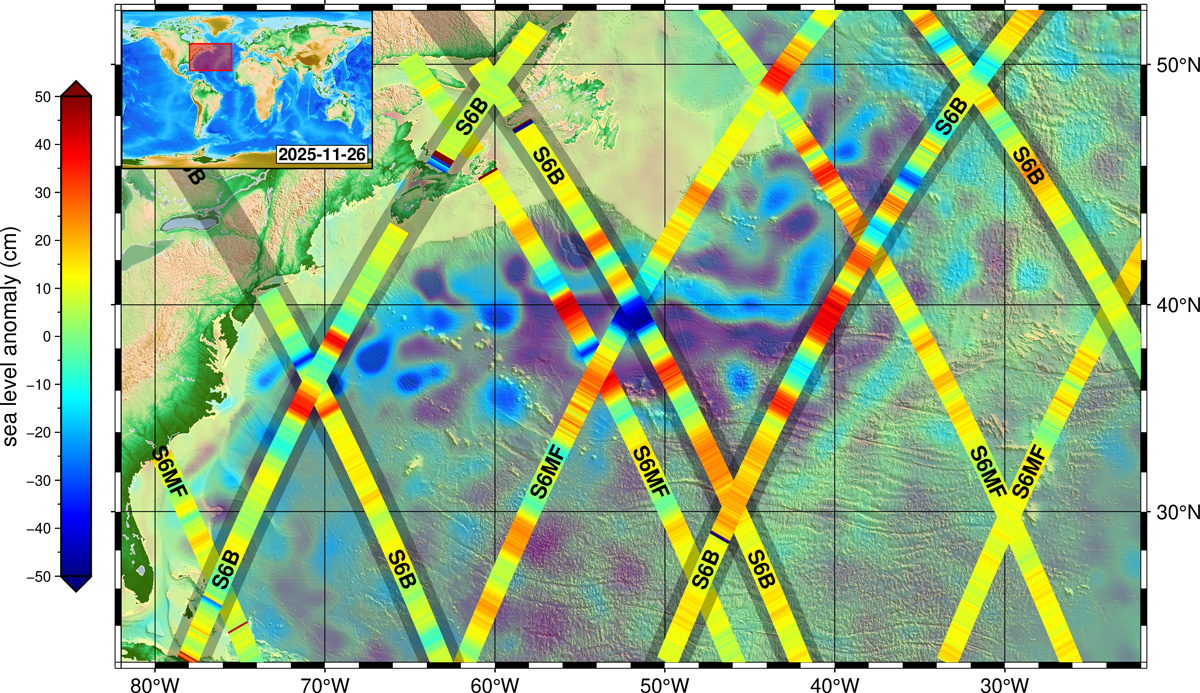
Colours along the tracks show sea level relative to a long-term average: red indicates higher-than-usual sea level, blue indicates lower-than-usual. Knowledge of Gulf Stream current systems is important for both ship routing and fisheries. The background image shows a global map of sea-surface height anomalies based on satellite altimeter data produced by the Copernicus Marine Service for
26 November 2025. All altimeter tracks display data collected on that same day. Image illustrative and not for operational use.
Image: Contains modified Copernicus Sentinel data (2025), processed by EUMETSAT
Christoph Kautz, Director for Space Policy, Earth Observation, and Satellite Navigation at the European Commission (DEFIS) stated: “These first images mark an exciting step for the Copernicus component of the EU Space Programme. Sentinel-6 Michael Freilich, the first satellite in the Sentinel-6 series, already delivers essential information on sea level, ocean currents and inland waters, supporting coastal protection and climate resilience. Sentinel-6B ensures this capability continues well into the future, showing how Europe’s long-term investments in space translate into tangible benefits for society.”
Sentinel-6B data will feed operational ocean forecasts from the Copernicus Marine Service, improve weather and seasonal prediction, and support long-term ocean and climate monitoring.
Satellite reaches final orbit — tandem flight begins
On 16 December, Sentinel-6B reached its final orbit at 1,336 km above Earth. The satellite is now flying just 30 seconds behind its predecessor, Sentinel-6 Michael Freilich, and will remain in this position for about ten months. This tandem phase will allow exceptionally precise cross-calibration of sea-level measurements — to within a fraction of a millimetre — ensuring a seamless continuation of the 30-year climate-quality sea-level record used worldwide, which is essential for understanding sea-level rise.
The Copernicus Sentinel-6 mission is the High-Precision Altimetry reference mission, against which other international altimetry missions are calibrated. Once operational, Sentinel-6B will replace Sentinel-6 Michael Freilich as the new reference altimetry satellite, while the latter will then move its ground track to interleave with Sentinel-6B, so optimising their combined observation of the global oceans. The continuation of such observations beyond 2030 is planned with a Sentinel-6C satellite, currently under discussion among the partners.
The Copernicus Sentinel-6 mission is the result of a partnership between the European Commission, EUMETSAT, the European Space Agency (ESA), the U.S. National Aeronautics and Space Administration (NASA), the U.S. National Oceanic and Atmospheric Administration (NOAA), with support from the Centre National d’Études Spatiales (CNES).
Images and further mission updates are available via EUMETSAT’s Sentinel-6B launch hub.
To learn more about NASA’s role in the Copernicus Sentinel-6 mission and its instruments, please visit NASA’s Sentinel-6 mission page.