Advancing ocean colour science: measurement training and comparison in Venice
Scientists from around the world met in Venice for advanced training in ocean-colour field measurements protocols for satellite calibration
In July 2025, a diverse group of researchers, early career scientists and doctoral students met in Venice, Italy, to explore best practices in ocean-colour field work. These high-quality observations underpin reliable satellite measurements.
03 February 2026
03 February 2026
A wealth of valuable clues about the health of the ocean can be found in its colour. Ocean colour alerts people to the presence of harmful bacteria, informs the monitoring of oil spills, and provides insight into the efficiency of the ocean to absorb carbon dioxide from the atmosphere, and much more.
A crucial carbon sink
“In the past, before ocean colour measurements existed, people thought of the world’s rainforests as the main great lungs of the Earth,” said Dr Juan Ignasio Gossn, EUMETSAT Remote Sensing Scientist.
“The Amazon rainforest has long been regarded as one of Earth’s most important terrestrial carbon sinks, absorbing carbon dioxide from the atmosphere, which it is. More recently, thanks to ocean colour observations made from space, it has been possible to verify that the oceans play an even larger role than the rainforests in the global carbon cycle as a critical carbon sink.”
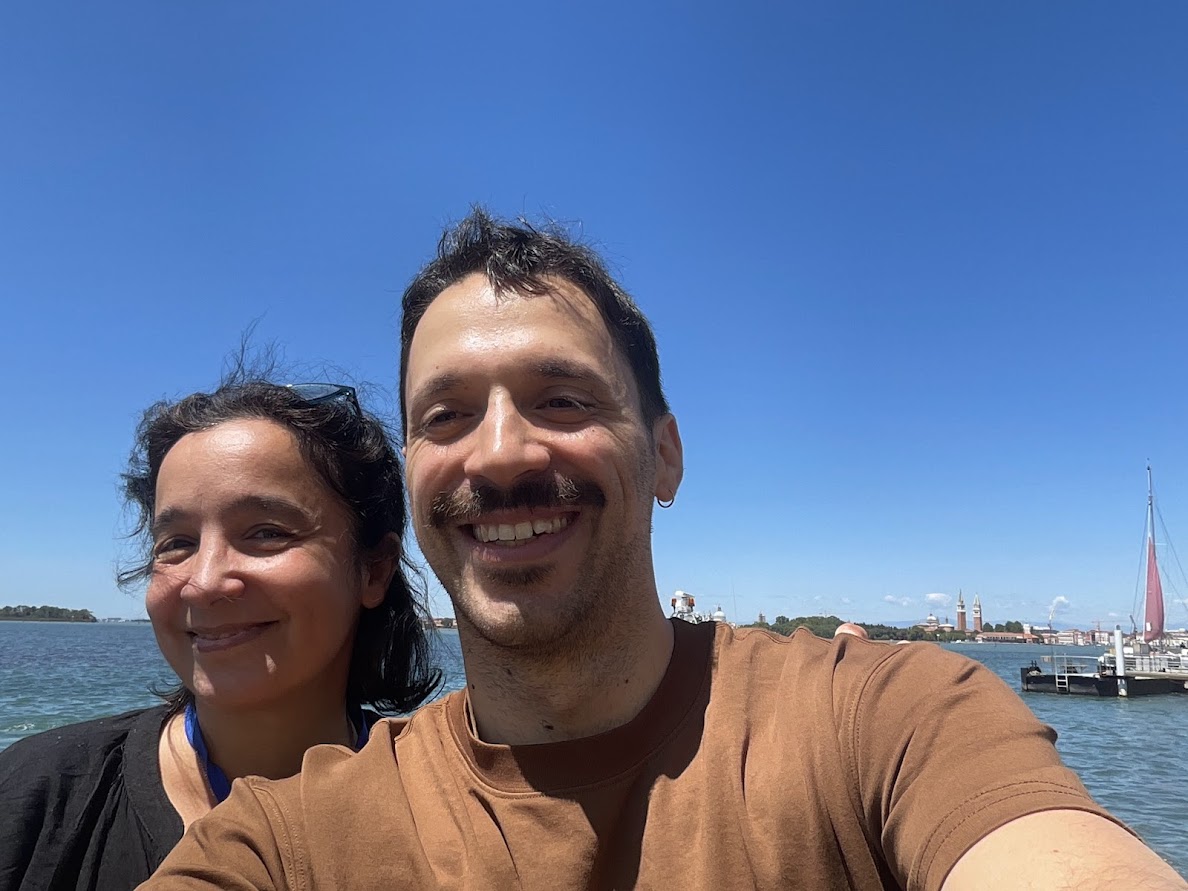
Credit: Juan Ignacio Gossn
The measurement of ocean colour by satellite instruments is essential for providing a global picture of the health of the ocean. Underpinning accurate satellite measurements are standard field measurements that the international community of ocean researchers and remote sensing specialists can use to validate and calibrate these satellite observations. These satellite observations include measurements from international ocean colour instruments including the Ocean and Land Colour Instrument on board Copernicus Sentinel-3 satellites and the Ocean Color Instrument on the United States’ National Aeronautics and Space Administration PACE satellite.
Exploring ocean colour
From 6 to 20 July, 30 oceanography experts met with students in Venice, Italy, for a training event focused on how to achieve high quality ocean colour field measurements for satellite validation, known as Fiducial Reference Measurements. The second EU Copernicus FRM4SOC training on in situ ocean colour above-water radiometry towards satellite validation drew together participants from across the globe, including from Europe, Asia, and the Americas. At the event, students studying remote sensing and other ocean topics had the opportunity to explore the details behind quality assurance and control of measurements, uncertainty assessment, and validated their field measurements using satellite observations covering the same areas.
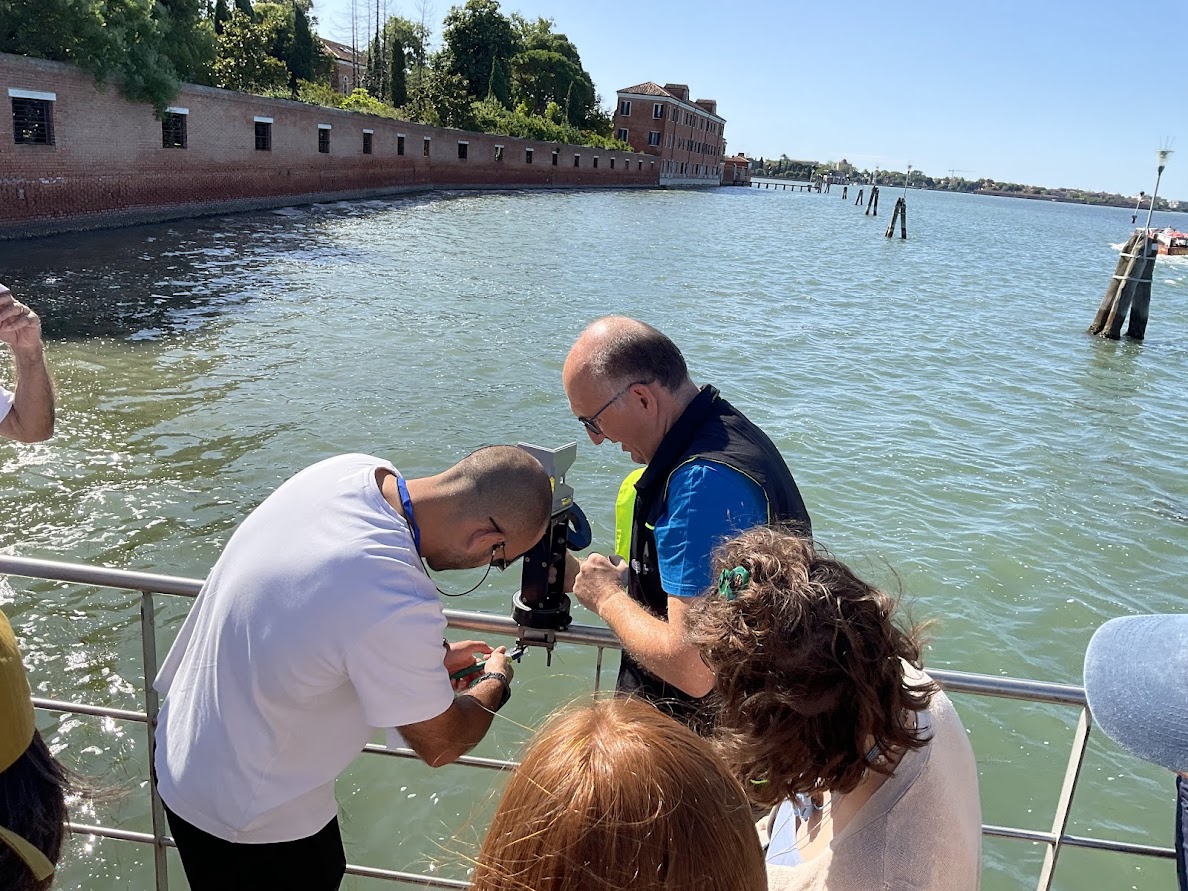
Credit: Juan Ignacio Gossn
“When we say ocean colour, it can sound simple, like the colour is green or blue,” said Gossn, who was also one of the conference organisers. “But colour actually spans a whole range of electromagnetic radiation. To properly quantify optically significant substances present in the water – particles that determine ocean colour that can potentially impact human activities – the sensors we use to measure ocean colour need to be very precise.
“Our measurements are sensitive to features of the water’s surface, air temperature, the polarisation of the light, and atmospheric features. We need to calibrate and characterise our sensors, follow a protocol for field measurements and correct for many undesired effects in order to be able to assess the intrinsic optical quality of the water.”
Putting theory into practice
Beyond the theoretical training, participants had the opportunity to witness and participate in a unique field comparison. On the Acqua Alta Oceanographic Tower, a cutting-edge research platform off the coast of Venice, the students operated eighteen of the same type of sensor under the same conditions to assess their compatibility. Then students returned to the Venice pier where they set-up their own field radiometry experiment, performed their own measurements, and used standardised software developed by the FRM4SOC project, EUMETSAT and NASA to process and validate them.
“What I enjoyed the most from the event was the day when all the students gathered in teams and went to the pier to perform their practice measurements,” said Gossn.
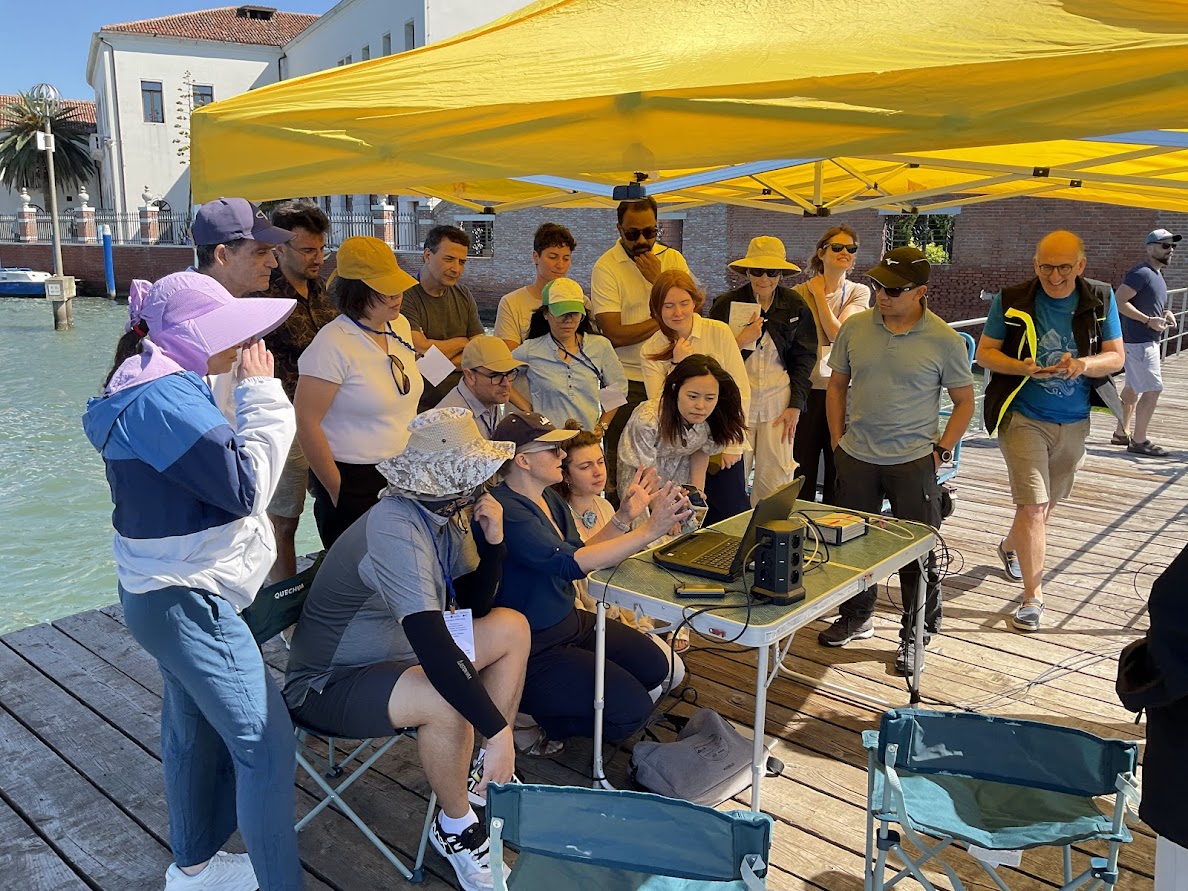
Credit: Juan Ignacio Gossn
“That day, there was a session when one of our experts, remote sensing professor Dr Krista Alikas from the University of Tartu in Estonia, was teaching the students how to run the sensors and monitor their status in real time. Everyone was asking questions and taking careful notes. It had been such hard work to bring the whole event together that I got a bit emotional then, feeling like it was having such a nice impact.
“For me, this is a good reflection of how science should work. Science is an international collaborative activity based on consensus, where people with different levels of expertise gather to give rise to a deeper understanding of the subject.
“It is really rewarding to be a part of fostering the giant effort to bring the international scientific community together and to contribute to advancing scientific knowledge of the ocean as the climate changes so rapidly.”
Author:
Sarah Puschmann